
Pantera Eyes $1.25B to Build a Solana Public Investment Firm

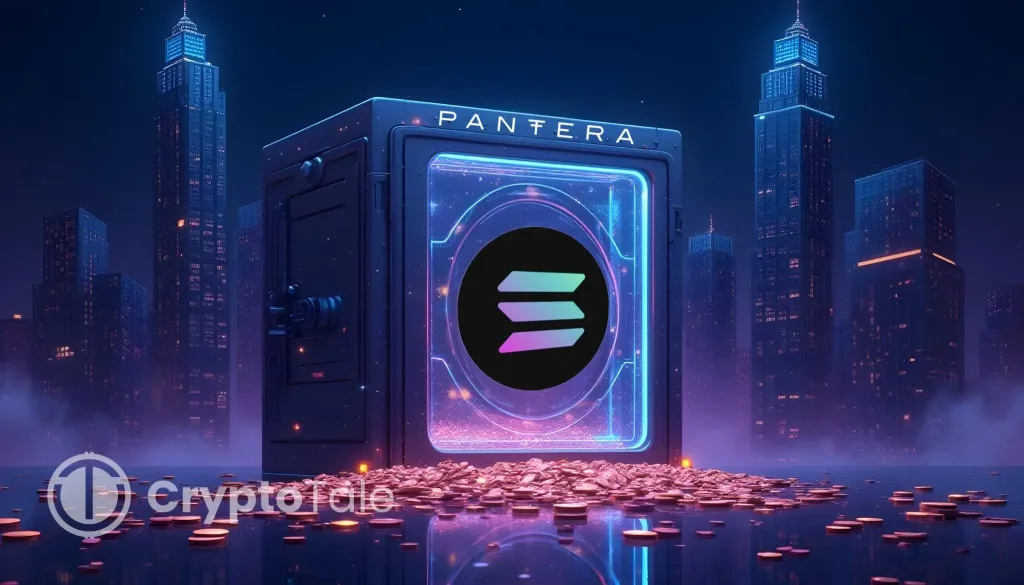
- Pantera Capital plans a $1.25B raise to build a Nasdaq-listed Solana treasury company.
- The firm would create one of the largest public reserves of SOL held by institutions.
- Public Solana treasuries now hold 3.71M SOL worth $700M, signaling rising corporate demand.
Pantera Capital is preparing a $1.25 billion plan that could reshape Solana’s place in institutional markets. The firm intends to convert a Nasdaq-listed company into a Solana treasury vehicle. According to sources, Pantera will start with a $500 million raise before issuing $750 million in warrants. The target company would be renamed “Solana Co.” and positioned as a public vehicle to hold Solana tokens.
Pantera has already invested heavily in digital asset treasury projects. Earlier this month, the firm revealed it deployed around $300 million into treasury firms across multiple cryptocurrencies. Its portfolio spans eight tokens, including Bitcoin, Ethereum, Solana, BNB, Toncoin, Hyperliquid, Sui, and Ethena.
In its blockchain letter, Pantera stressed that a digital asset treasury’s success depends on the long-term strength of the underlying token. The firm expects treasury firms to generate yield while growing net asset value through token accumulation.
Furthermore, earlier this week, Pantera joined ParaFi Capital in backing Sharps Technology, a Solana treasury vehicle seeking to raise more than $400 million. That deal added to Pantera’s growing list of treasury-focused bets, including Twenty One Capital and DeFi Development Corp, underscores its commitment to positioning Solana as a cornerstone of institutional crypto adoption.
Solana’s Expanding Treasury Market
Pantera’s push comes as other major firms also build Solana treasuries. Galaxy Digital, Jump Crypto, and Multicoin Capital are jointly raising $1 billion for a Solana-focused reserve. Others, such as Upexi and DeFi Development Corp, have also added Solana through equity raises. Upexi now holds over 2 million SOL, the largest single corporate reserve on record.
As per CoinGecko data, the total size of the public Solana treasuries is about 3.71 million SOL, which is worth around $700 million, representing 0.69% of the total supply of Solana tokens. This steady accumulation points to the structural force of demand, as institutions consider Solana as a long-term portfolio asset.
Pantera’s planned raise would mark the largest corporate Solana treasury to date. The firm aims to establish Solana Co. as a flagship public entity by combining equity capital and warrants. The model indicates the change in the way digital assets enter the traditional markets. Instead of ETFs, treasury firms accumulate tokens directly and grow their reserves over time.
Related: Institutional Solana Staking Yields Boost Market Confidence
The strategy also mirrors Strategy’s Bitcoin playbook. Strategy began accumulating Bitcoin in 2020, positioning itself as a public proxy for exposure. Pantera now appears to be building the same model for Solana, potentially giving Wall Street a new entry point.
If Pantera’s $1.25 billion initiative succeeds, it would tighten Solana’s circulating supply. Combined with parallel treasury projects, this could create long-term price resilience. More importantly, it would legitimize Solana as an institutional-grade asset class.
The move towards Solana-related corporate organizations marks a turning point in digital assets. At press time, Solana (SOL) traded at $188.96, ranking at 6th place among cryptocurrencies. The token recorded a 4.96% gain over the past week, with a market cap of $102.14 billion.
The post Pantera Eyes $1.25B to Build a Solana Public Investment Firm appeared first on Cryptotale.
Disclaimer: The content of this article solely reflects the author's opinion and does not represent the platform in any capacity. This article is not intended to serve as a reference for making investment decisions.
You may also like
The Reserve Bank of India’s Efforts to Save the Rupee Deplete Reserves: $50 Billion Plunge in Forex Holdings, $200 Billion Forward Dollar Liabilities Become a Ticking Time Bomb
Foreign investors have made net sales of $31 billion in Indian stocks this year, and administrative controls are accelerating hedging demand towards the offshore NDF market, with the effectiveness of interventions continuously diminishing. The most critical risk lies in the fact that the yield spread between Indian and US 10-year government bonds has sharply dropped from 600 basis points in 2013 to just 200 basis points, with the traditional interest rate defense line nearly breached. India faces a dilemma: persisting on the current path will exhaust policy space, while relying on rate hikes to rebuild the yield spread would directly stifle economic growth.

As Starlink challenges telecom operators' pricing power, AT&T (T.US) sells its Mexico business for $2 billion, shifting focus to AI connectivity demand.
AT&T has agreed to sell its Mexico operations to Televisa and Fintech for $2 billion. The transaction is expected to be completed in the first quarter of 2027, pending approval from Mexican regulators.


Dovish Signals Boost Markets: Asia-Pacific Stocks Rebound, South Korea Shares Jump Over 1% Ending Five-Day Slide, Taiyo Yuden Surges 7%
On Wednesday, the MSCI Asia-Pacific Index rose by 0.2%, making a slight rebound from the low point reached on Tuesday, the lowest since August. South Korea's Composite Index briefly rose by over 2%. SK Hynix and Samsung Electronics both surged more than 3% during trading, then fell back. The Nikkei 225 expanded its gains to 0.53%. MLCC giant Taiyo Yuden led the AI hardware sector, while Fujikura rose nearly 4%. The yield on 10-year US Treasury futures remained at 5.21%, up 0.5 basis points from Tuesday.

Crypto prices
More


