
Bitcoin Mining Survival Line: After Profits Plunge 35%, How Do Miners Survive?

With Bitcoin prices falling and mining difficulty and costs rising, many miners are approaching the breakeven point, forced to rely on coin hoarding and external financing to maintain operations.
Original Title: The Miners's Mirage
Original Author: Prathik Desai, Token Dispatch
Original Translation: Chopper, ForesightNews
The financial logic for bitcoin miners is very simple: they survive on fixed protocol income but face fluctuating real-world expenses. When the market is volatile, they are the first group to feel pressure on their balance sheets. Miners’ income comes from selling the bitcoin they mine, while their operating costs are mainly the electricity required to run the heavy-duty computers used for mining.
This week, I tracked some key data on bitcoin miners: the rewards paid by the network to miners, the cost of earning this income, the remaining profit after deducting cash expenses, and the final net profit after accounting adjustments.
At the current bitcoin price below $90,000, miners are in trouble. Over the past two months, miners’ 7-day average income has dropped 35% from $60 million to $40 million.
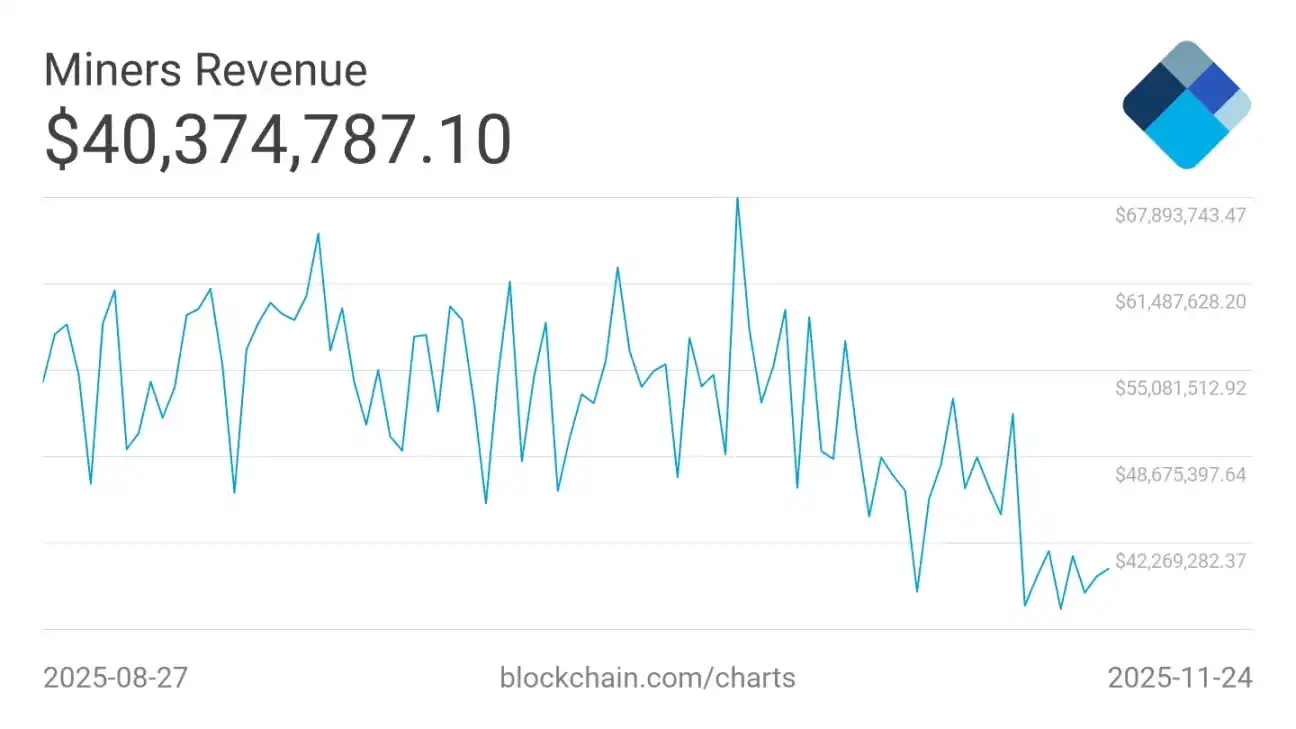
Let me break down the key logic in detail.
Bitcoin’s income mechanism is fixed and coded into the protocol. Each block’s mining reward is 3.125 bitcoins, with an average block time of 10 minutes, resulting in about 144 blocks per day, which means the entire network produces about 450 bitcoins daily. Calculated over 30 days, global bitcoin miners mine a total of 13,500 bitcoins, which, at the current price of about $88,000 per bitcoin, is worth approximately $1.2 billion. But if this income is distributed across the record-high 1078 EH/s (exahash) of hash rate, the final income per TH/s (terahash) of hash rate per day is only 3.6 cents. This is the entire economic foundation supporting the secure operation of this $1.7 trillion network. (Note: 1 EH/s = 10^18 H/s; 1 TH/s = 10^12 H/s)
On the cost side, electricity is the most critical variable, and its cost depends on the mining location and the efficiency of the mining machines.
If using modern S21-level miners (17 joules per terahash) and cheap electricity, miners can still achieve cash profitability. But if the mining machines are mainly old equipment or if high electricity prices must be paid, every hash calculation increases costs. At the current hash price (affected by network difficulty, bitcoin price, block subsidy, and transaction fees), an S19 miner using electricity at $0.06 per kWh can barely break even. If network difficulty rises, bitcoin price drops slightly, or electricity prices soar, its economic efficiency will further deteriorate.
Let me analyze with some specific data.
In December 2024, CoinShares estimated that the cash cost for listed mining companies to mine 1 bitcoin in Q3 2024 was about $55,950. Now, Cambridge University estimates this cost has risen to about $58,500. The actual mining costs vary among miners: the world’s largest listed bitcoin mining company, Marathon Digital (stock code MARA), had an average energy cost of $39,235 per bitcoin mined in Q3 2025; the second largest listed miner, Riot Platforms (stock code RIOT), had a cost of $46,324. Although the bitcoin price has dropped 30% from its peak to $86,000, these mining companies are still profitable. But that’s not the whole story.
Miners also need to consider non-cash expenses, including depreciation, impairment, and stock option compensation, all of which make mining a capital-intensive industry. Once these costs are included, the total cost of mining 1 bitcoin can easily exceed $100,000.
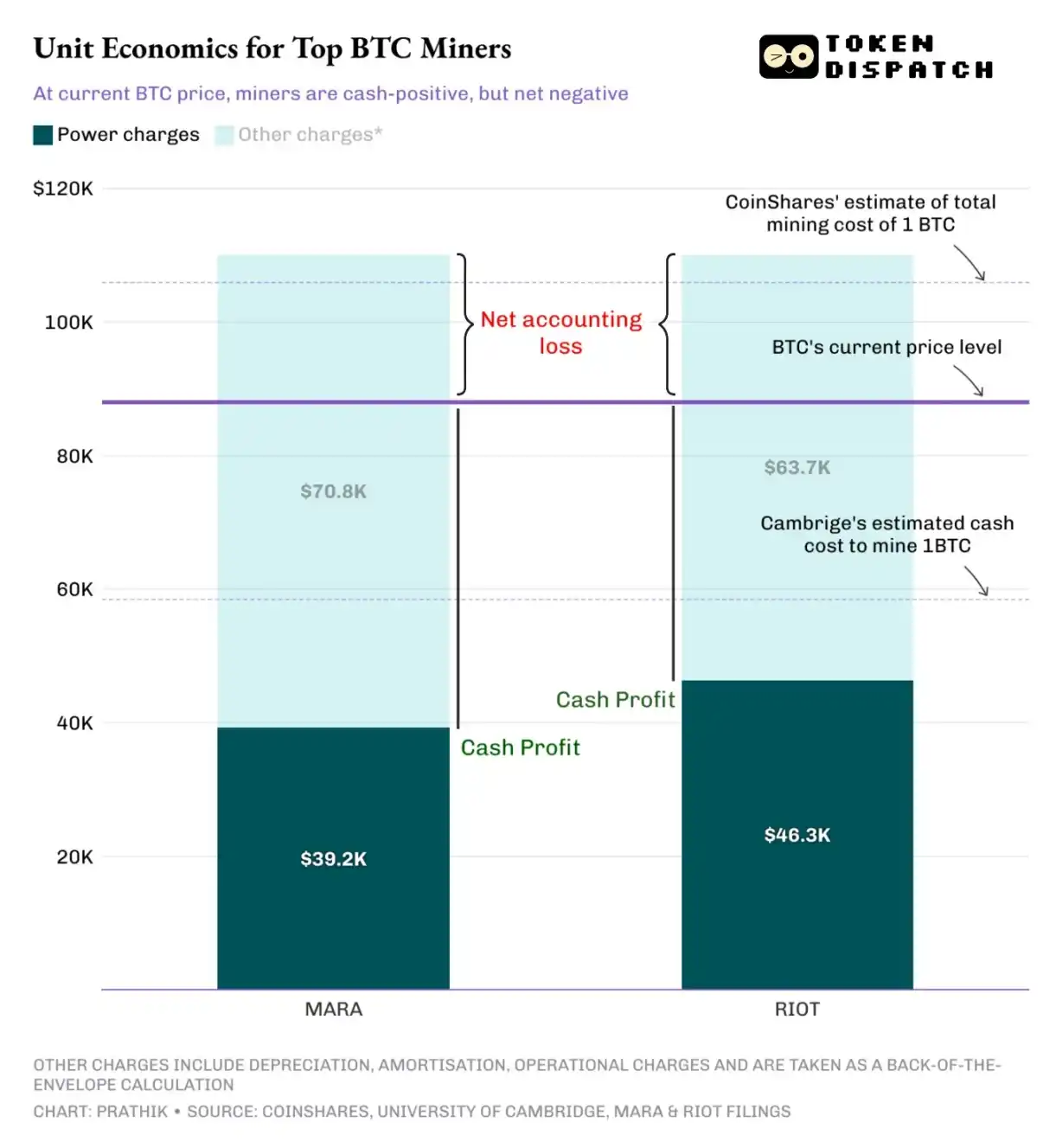
Mining costs for top miners Marathon and Riot
MARA uses both its own miners and third-party hosted equipment. MARA needs to pay for electricity, depreciation, and hosting fees. Rough calculations show that its total mining cost per bitcoin exceeds $110,000. Even CoinShares’ estimate in December 2024 put the total mining cost at about $106,000.
On the surface, the bitcoin mining industry appears robust. Cash profit margins are substantial, accounting profits are possible, and the scale of operations is large enough to raise funds at will. But if you look deeper, you’ll understand why more and more miners choose to hold the bitcoin they mine, or even accumulate more bitcoin from the market, instead of selling immediately.
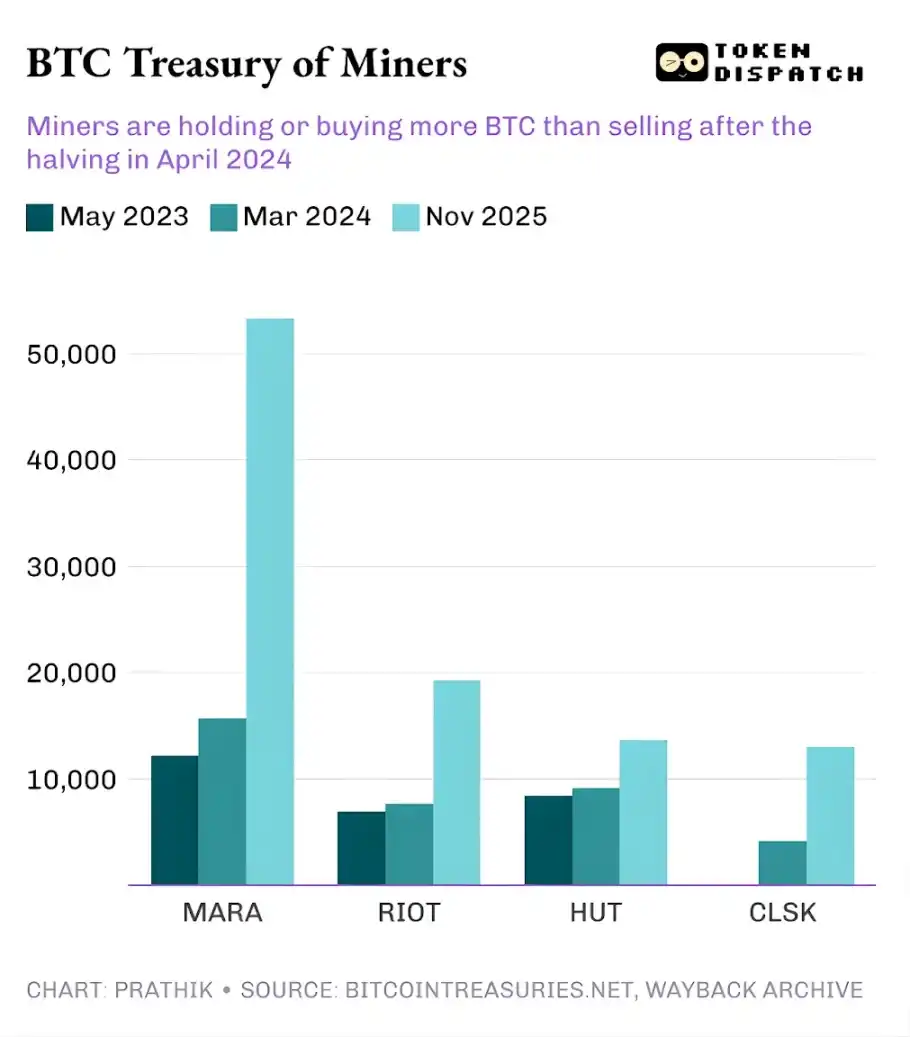
Bitcoin reserves of leading mining companies
Stronger miners like MARA can cover their costs because they have auxiliary businesses and access to capital markets. However, many other miners could fall into losses with just one more increase in network difficulty.
Overall, there are two coexisting breakeven scenarios in the mining industry:
The first is large industrial miners, who have efficient machines, cheap electricity, and light-capital balance sheets. For them, daily cash flow only turns negative when the bitcoin price drops from $86,000 to $50,000. Currently, their cash profit per bitcoin mined exceeds $40,000, but whether they can achieve accounting profits at current price levels depends on the miner.
The second is the rest of the miners, who will find it difficult to break even once depreciation, impairment, and stock option expenses are included.
Even with a conservative estimate of the comprehensive cost per bitcoin between $90,000 and $110,000, it means many miners have already fallen below the economic breakeven point. They can continue mining because their cash costs have not yet been breached, but their accounting costs have already been exceeded. This may prompt more miners to choose to hold bitcoin rather than sell now.
As long as cash flow remains positive, miners will continue mining. At the $88,000 price level, the whole system appears stable, but this premise is based on miners not selling bitcoin. If the bitcoin price drops further, or miners are forced to liquidate their holdings, they will approach the breakeven line.
Therefore, although price crashes will continue to affect retail and trading groups, it is currently unlikely to hurt miners. However, if miners’ financing channels become more restricted, the situation could worsen. At that point, the growth flywheel will break, and miners will have to increase their investment in auxiliary businesses to maintain operations.
Disclaimer: The content of this article solely reflects the author's opinion and does not represent the platform in any capacity. This article is not intended to serve as a reference for making investment decisions.
You may also like
Meta (META.US) "cuts" the camera: $349 Ray-Ban glasses equipped with Muse and hearing aid functions
Meta Platforms (META.US) is expanding its smart glasses product line with a camera-free model, support for the popular new assistant Muse, and a hearing aid mode.
Is Tesla (TSLA.US) about to release its most expensive model? Roadster launch imminent, but options market remains indifferent
Tesla Roadster is scheduled for release on October 1st, and may become its most expensive model, but the options market has not heated up in advance.
Catering giant ventures into advertising! McDonald's (MCD.US) builds its own media network, targeting a $1 billion high-profit business
McDonald's is following in the footsteps of retail giants such as Amazon and Walmart by announcing plans to build its own media network.
Understanding the US Treasury's "Black Wednesday": The "Perfect Storm" Impact and the Rising Tide of "October Rate Hike"
U.S. Treasury bonds suffered their worst single-day sell-off in nearly 18 months: surging oil prices, explosive PMI data, hawkish comments from the Federal Reserve, and a lackluster 5-year Treasury auction combined to create four simultaneous negative factors. The 10-year yield broke above 5.1%, reaching a new high since 2007; the market's probability of another rate hike in October soared to 68%, and the swap market is now pricing in expectations of three rate hikes over the next year. Analysts believe that more than 80% of this sell-off is driven by real interest rates, with the 30-year mortgage rate surpassing 7% and doubts persisting about the effectiveness of the Treasury’s buyback plan.
Crypto prices
More


