
Reliance Global Shifts Entire Crypto Treasury Into Zcash After Strategic Overhaul

Quick Breakdown
- Reliance Global Group has fully switched its digital asset treasury from Bitcoin, Ethereum, and others to Zcash.
- The Nasdaq-listed firm says ZEC’s privacy features and regulatory flexibility align better with its long-term strategy.
- Renewed market interest, regulatory clarity and major exchange relistings have driven ZEC’s resurgence.
Reliance makes a bold bet on privacy coins
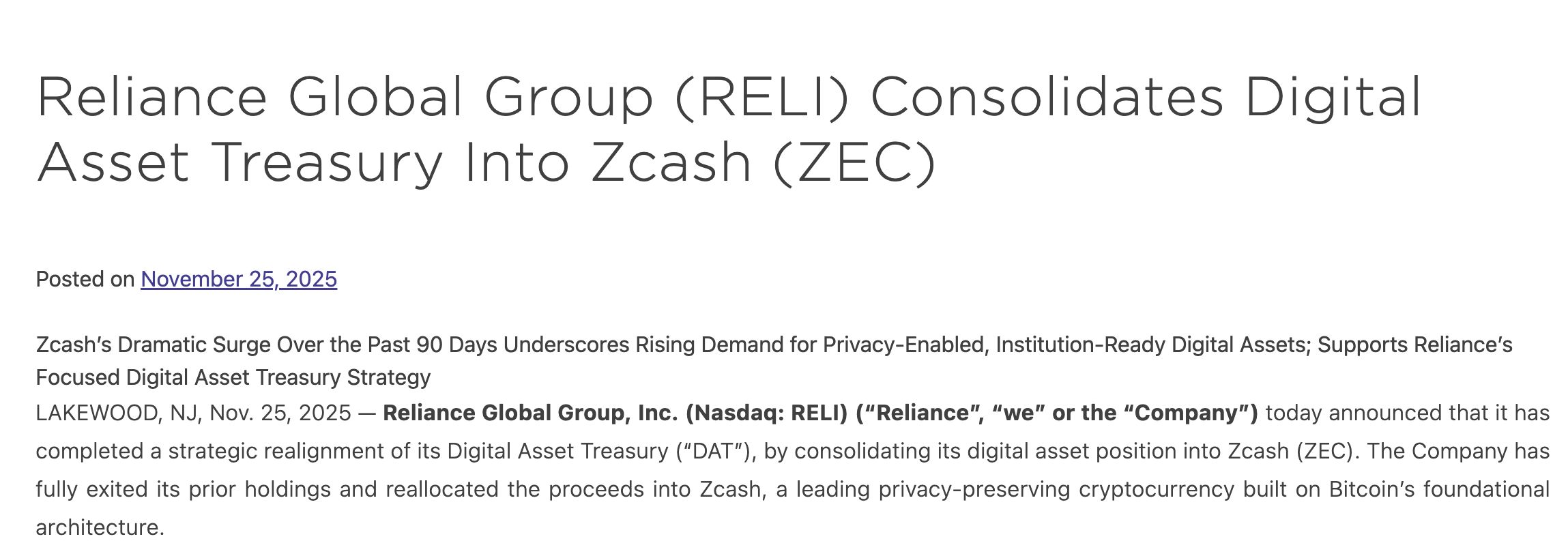
Nasdaq-listed insurance technology firm Reliance Global Group has taken a dramatic turn in its crypto strategy, consolidating its entire digital asset treasury into the privacy-focused cryptocurrency Zcash (ZEC). The shift marks the company’s strongest endorsement yet of privacy tech within the blockchain space.
 Source:
Reliance Global
Source:
Reliance Global
Moshe Fishman, a member of the firm’s Crypto Advisory Board, said the decision reflects “deep conviction” in Zcash’s long-term role at the intersection of cryptography, compliance, and financial privacy. The announcement was made on November 25.
From diversified portfolio to single-asset focus
Reliance originally entered the crypto market in September with a diversified approach anchored by Bitcoin, alongside Ethereum, Cardano, XRP and Solana. The company even made a significant Solana purchase last month as part of its “multiple value proposition” strategy.
However, a comprehensive strategic review led by Crypto Advisory Board Chairman Blake Janover prompted a complete pivot. The board concluded that Zcash offers the most compelling foundation for Reliance’s long-term Digital Asset Treasury (DAT) plan.
Executives highlighted Zcash’s dual transaction model, which supports both transparent and shielded transfers, as a major advantage. CEO Ezra Beyman noted that focusing on ZEC allows the company to “operate with greater clarity” as the digital economy evolves.
Zcash rides the wave of renewed market and regulatory momentum
Zcash has been one of the standout performers of the past quarter, rallying more than 1,200% in 90 days, its most substantial surge since 2018. This momentum stems from rising demand for privacy-centric tokens amid concerns about on-chain surveillance on public blockchains like Bitcoin and Ethereum.
Exchanges are taking notice, too. OKX, which previously delisted ZEC, reinstated the token this week amid renewed demand, a move many expect other platforms to follow.
Institutions begin to re-enter the Zcash ecosystem
Institutional interest is also resurfacing. Cypherpunk Technologies, backed by the Winklevoss twins, recently acquired more than 200,000 ZEC as part of its strategic repositioning. Activity around the Grayscale Zcash Trust has risen, while influential industry figures like Arthur Hayes have openly backed the asset.
Take control of your crypto portfolio with MARKETS PRO, DeFi Planet’s suite of analytics tools.”
Disclaimer: The content of this article solely reflects the author's opinion and does not represent the platform in any capacity. This article is not intended to serve as a reference for making investment decisions.
You may also like
Meta (META.US) "cuts" the camera: $349 Ray-Ban glasses equipped with Muse and hearing aid functions
Meta Platforms (META.US) is expanding its smart glasses product line with a camera-free model, support for the popular new assistant Muse, and a hearing aid mode.
Is Tesla (TSLA.US) about to release its most expensive model? Roadster launch imminent, but options market remains indifferent
Tesla Roadster is scheduled for release on October 1st, and may become its most expensive model, but the options market has not heated up in advance.
Catering giant ventures into advertising! McDonald's (MCD.US) builds its own media network, targeting a $1 billion high-profit business
McDonald's is following in the footsteps of retail giants such as Amazon and Walmart by announcing plans to build its own media network.
Understanding the US Treasury's "Black Wednesday": The "Perfect Storm" Impact and the Rising Tide of "October Rate Hike"
U.S. Treasury bonds suffered their worst single-day sell-off in nearly 18 months: surging oil prices, explosive PMI data, hawkish comments from the Federal Reserve, and a lackluster 5-year Treasury auction combined to create four simultaneous negative factors. The 10-year yield broke above 5.1%, reaching a new high since 2007; the market's probability of another rate hike in October soared to 68%, and the swap market is now pricing in expectations of three rate hikes over the next year. Analysts believe that more than 80% of this sell-off is driven by real interest rates, with the 30-year mortgage rate surpassing 7% and doubts persisting about the effectiveness of the Treasury’s buyback plan.
Crypto prices
More


