
Nonfarm Payrolls Preview! Unemployment Rate Hits the Critical 4.4% Threshold—Will the U.S. Economy Fall Off a Cliff?

FXStreet, February 10—— This week, the United States will release both the January Nonfarm Payrolls (NFP) data and the Consumer Price Index (CPI). These two key reports will directly determine the pace of the Federal Reserve’s interest rate cuts in 2026, and even whether rate cuts will occur at all, becoming critical references for the market to judge the U.S. economy and monetary policy.
Last autumn, a sluggish and volatile labor market was the core concern of the Federal Reserve. To hedge against the risks of rising unemployment and a sharp cooling in hiring, the Fed cut the benchmark interest rate three times by the end of 2025, making every effort to stabilize the job market.
Now, market focus has shifted back to the persistent issue of high inflation.
The U.S. Bureau of Labor Statistics (BLS) releases its annual benchmark revision in the January employment situation report (usually published in February) every year.

Labor Market: Stabilization and Divergence Coexist, Supporting a Pause in Rate Cuts
In the summer of 2025, the U.S. saw a contraction in jobs, but the last two months of the year saw a phase of recovery in hiring. The unemployment rate, after hitting a four-year high, edged down to 4.4% in December.
However, there are clear divergences in market expectations for the job outlook: The Federal Reserve believes the labor market has stabilized, but some Wall Street institutions point out that job vacancies have dropped sharply and the fundamentals of employment are still deteriorating.
Based on confidence in the job market, the Fed voted 10:2 at the end of January to pause rate cuts, the first time in four meetings to hold its position. Most officials have no plans for rate cuts in the short term due to unmet inflation targets.
Inflation Trend: Short-term Slowdown with Upside Risks Remaining
On the inflation front, January data is expected to show a slight slowdown, with institutions forecasting both headline and core CPI to rise 0.3% month-on-month, and decline year-on-year to 2.5%.
The mainstream view is that the impact of tariffs will gradually fade in 2026, and slower increases in housing and labor costs will help inflation continue to move closer to the 2% target.
Policy Impact: Data Results Determine Pace of Rate Cuts and Market Direction
Domestic employers announced 108,435 layoffs in the month, up 118% year-on-year and 205% month-on-month, marking the highest level for the same period since January 2009 and the single-month peak since October 2025;
Summary and Technical Analysis:
The most important observation for this nonfarm payrolls report remains the unemployment rate. According to the Sahm Rule, when the three-month moving average of U.S. unemployment rises by 0.5 percentage points above the lowest point of the previous 12 months, the economy officially enters a recession. That 0.5% threshold is at 4.4%. Economists also believe the Beveridge curve inflection point is at 4.4%. Exceeding this point means the labor market is not just cooling, but in recession. Empirically, in July 2024, the unemployment rate once touched 4.3%, which triggered a global “Black Monday” market rout.
Technical indicators show the U.S. dollar index fell on Monday,
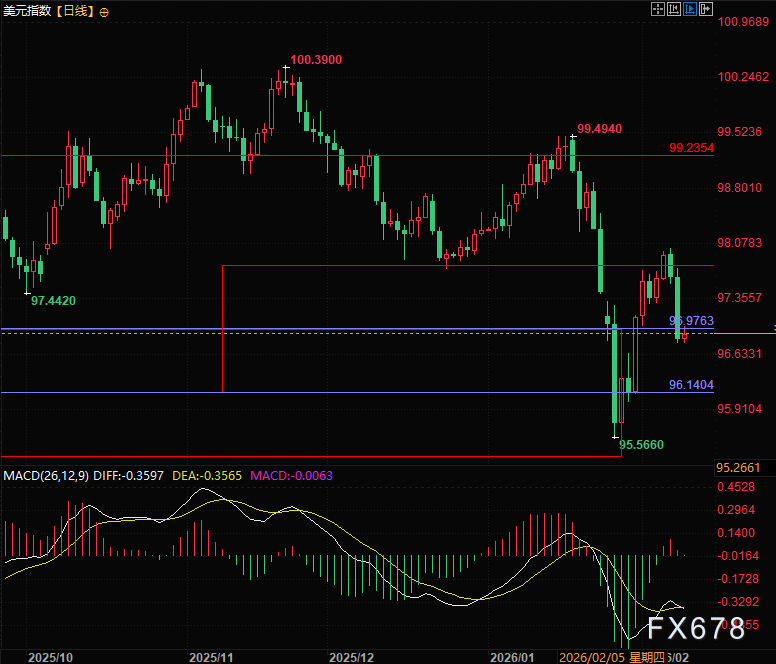
(U.S. Dollar Index daily chart, source: Yihuitong)
As of 15:57 Beijing time (UTC+8), the U.S. dollar index is at 96.91.
Disclaimer: The content of this article solely reflects the author's opinion and does not represent the platform in any capacity. This article is not intended to serve as a reference for making investment decisions.
You may also like
US Treasury "Extreme Short Sellers" Gather! With Oil Prices and Treasury Yields "Dual Pressure," Rate Hike Expectations Surge, Market Bets Real Money on a New Round of Tightening
According to some veteran Wall Street analysts, the most favorable combination for the market is a small rate hike accompanied by a clear data-dependent stance, allowing investors to interpret it as a limited and moderate monetary policy adjustment to guard against recurring inflation.

Intel CEO: CPU only meets 50% of demand, 14A to start production in Q1 next year, new architecture may reduce inference power consumption to 1/15 of GPU
Intel CEO Pat Gelsinger stated that the era of AI agents has triggered an explosion in CPU demand, and Intel is currently able to meet only about 50% of its customers' supply needs, with several tech giant CEOs calling to secure supply. In terms of manufacturing process, the 18A node is now in full mass production, while the 14A node will begin production in the first quarter of next year. By opening up factory data, yield rates are improving by about 7% annually. Additionally, he is advancing neuromorphic computing to address energy consumption bottlenecks and expects quantum computing to have a substantial industrial impact within 3 to 5 years.
Crypto prices
More


