
USD: K-shaped, from divergence to convergence

In recent years, there has been a useful framework for understanding the US dollar exchange rate: the K-shaped divergence. The so-called K-shape means that the US economy has both strong components (such as the stock market and GDP) and weaker ones (employment and low-income groups).
Mapped to the foreign exchange market, the "K-shaped divergence" means that understanding the US dollar should not be too one-sided.When the market is extremely bullish on the US dollar and believes there is no basis for depreciation (with RR implied volatility at high levels), the actual result often falls short of expectations; conversely, when the market is extremely bearish on the dollar and believes its collapse is imminent (with RR implied volatility at low levels), the actual result often exceeds expectations.
There are countless cases to cite—anyone who follows the forex market must have experienced this. Essentially, against the backdrop of "K-shaped divergence," understanding the US dollar should not be overly one-sided.
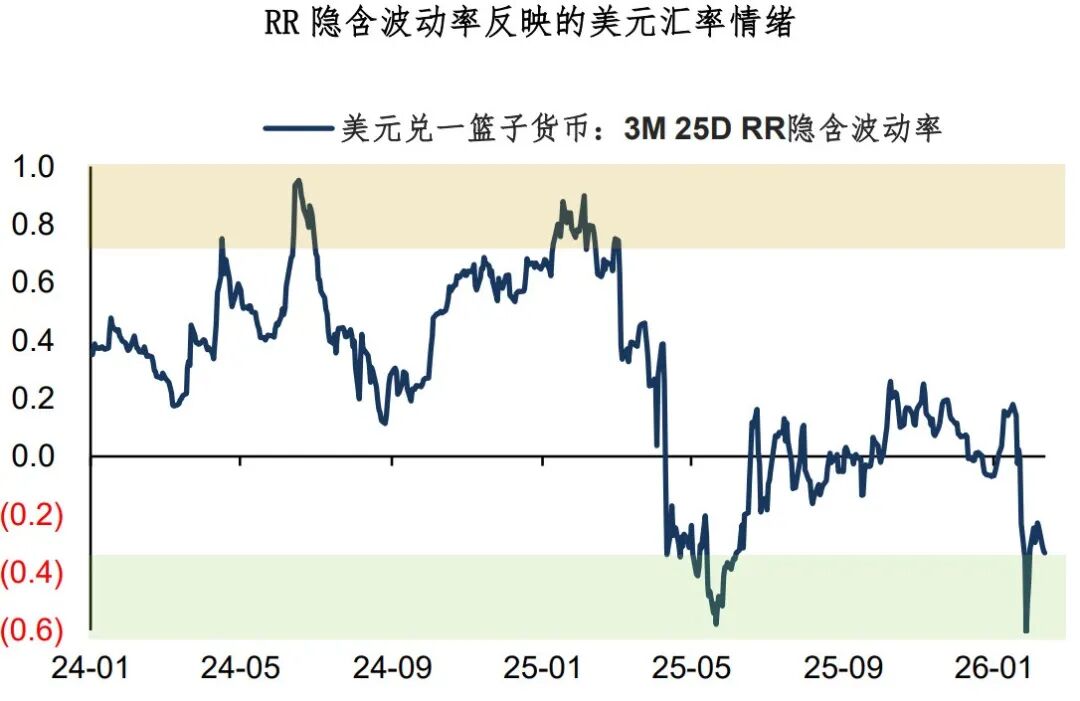
Looking at the situation since the beginning of the year, the "K-shaped divergence" pattern can still be observed, but potential changes have emerged.On one hand, the upper leg of the K-shape (US stocks & consumption) is showing clear signs of loosening; on the other hand, the lower leg of the K-shape (employment) has not further deteriorated, with the employment landscape showing a weak equilibrium.
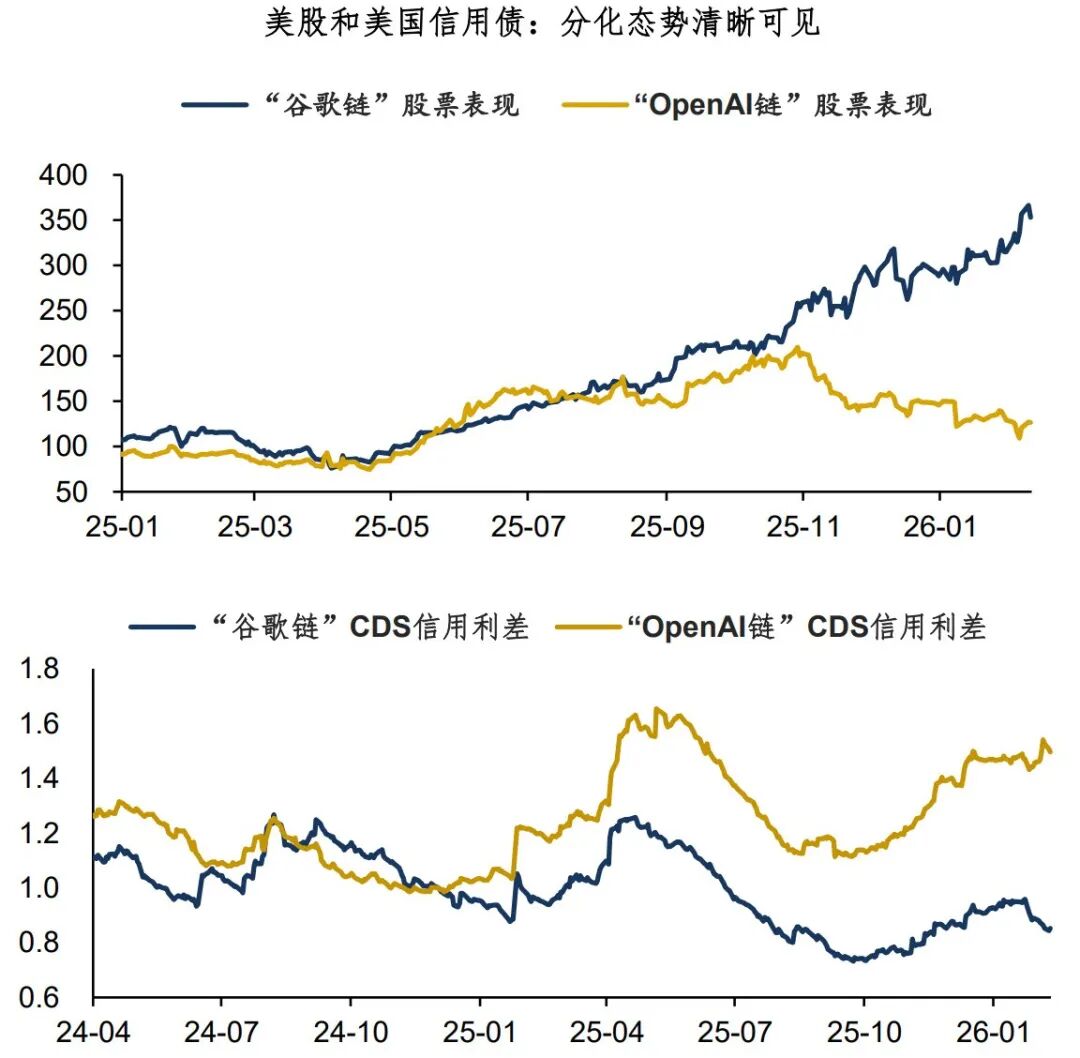
First, the divergence in US stocks is clearly visible.The "Google chain" and "OpenAI chain" are showing obvious divergence, which is further evolving into the credit bond market. The CDS credit spreads of the "OpenAI chain" are clearly on the rise. If companies on these two chains continue to diverge rather than prosper together, it may be difficult for the US stock market to achieve a broad bull market in 2026 (refer to "US Dollar: US Stocks Gradually Changing").
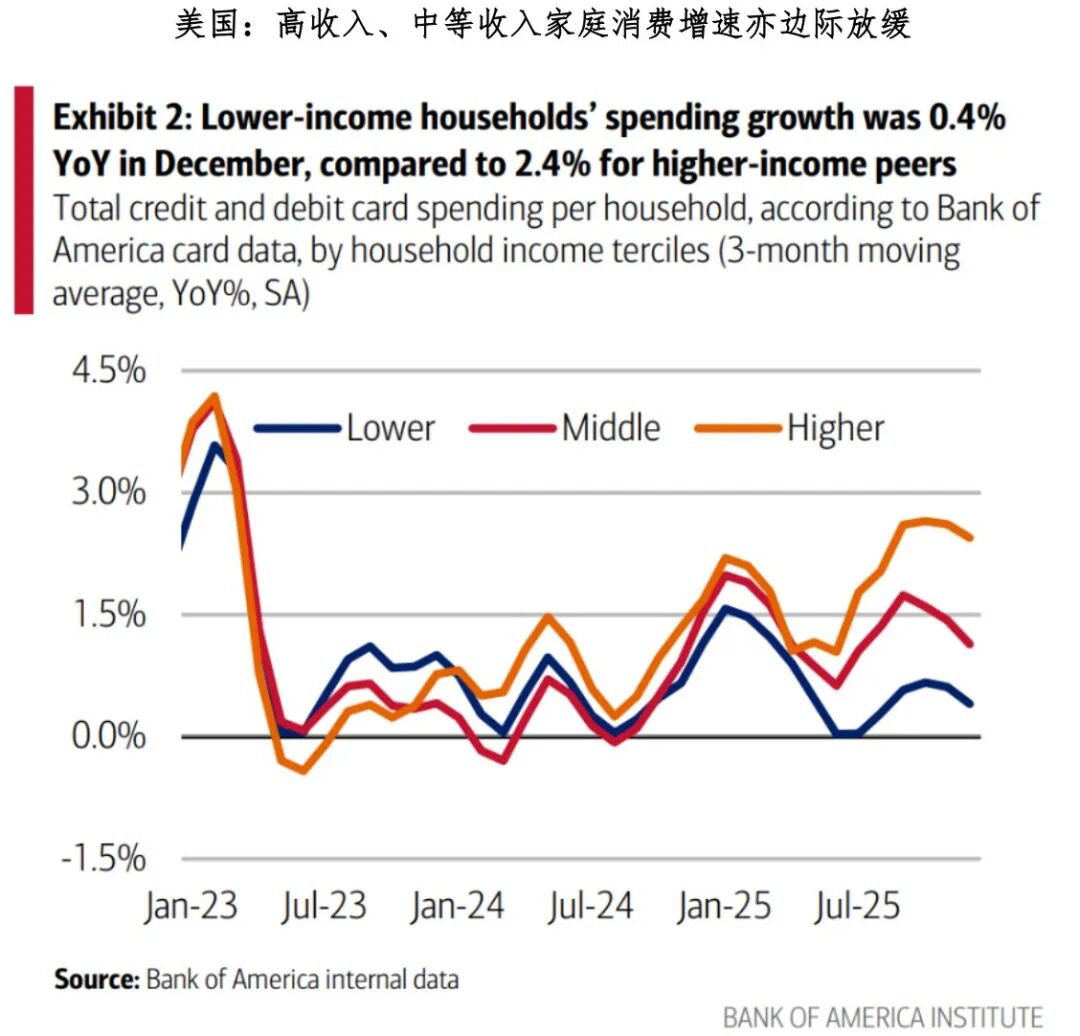
Furthermore, strong consumer spending is also showing signs of weakening.For example, December retail sales data was flat at +0% month-on-month, reflecting a slowdown after the earlier promotional season. In addition, Bank of America client data shows that US household spending has slowed in recent months, with even previously resilient middle- and high-income group consumption showing signs of weakening.
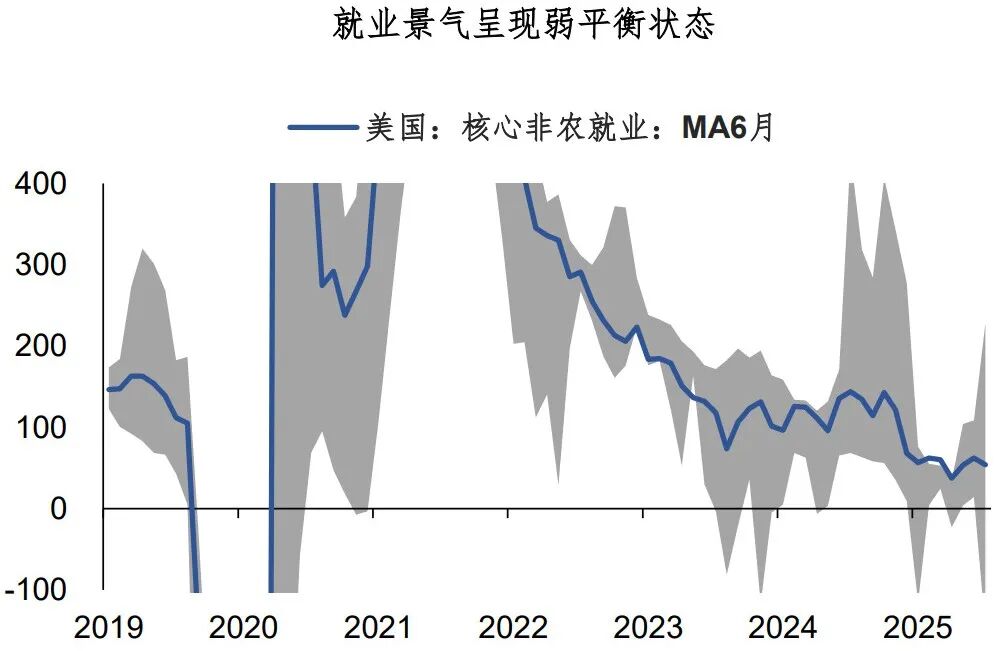
Although the upper leg of the K-shape (US stocks & consumption) is clearly loosening, the lower leg (employment) has not further weakened.In fact, high-frequency data such as job postings had already shown signs of stabilization at low levels earlier, and last night's major non-farm payroll further confirmed this—unemployment rate at 4.3% and 130,000 new non-farm jobs. Admittedly, a single month's data is not enough to indicate an employment recovery, but considering several metrics, the employment landscape does indeed present a weak equilibrium.
Overall, in the first half of this year, the theme for the US dollar seems to be shifting from "K-shaped divergence" to "K-shaped convergence."This may mean that volatility among G7 exchange rates will tend to decline, for a simple reason—extreme divergence easily leads to sharp differences in expectations, while a converging market tends to be "tepid." The US dollar exchange rate and US Treasury yields will generally fluctuate within a range.
To summarize today’s sharing:
1. In recent years, there has been a useful framework for understanding the US dollar exchange rate: K-shaped divergence. Mapped to the foreign exchange market, the K-shape means that understanding the dollar should not be too one-sided, and crowded sentiment often breeds contrarian trading opportunities;
2. As we approach 2026, the "K-shaped divergence" remains evident, but potential changes have emerged. On one hand, the upper leg of the K-shape (US stocks & consumption) is showing clear signs of loosening; on the other hand, the lower leg (employment) has not further deteriorated, with the labor market showing a weak equilibrium;
3. Overall, in the first half of this year, the theme for the US dollar seems to be shifting from "K-shaped divergence" to "K-shaped convergence." This may mean that volatility among G7 exchange rates will tend to decline, while the US dollar exchange rate and US Treasury yields will generally fluctuate within a range.
Disclaimer: The content of this article solely reflects the author's opinion and does not represent the platform in any capacity. This article is not intended to serve as a reference for making investment decisions.
You may also like
Intel CEO: CPU only meets 50% of demand, 14A to start production in Q1 next year, new architecture may reduce inference power consumption to 1/15 of GPU
Intel CEO Pat Gelsinger stated that the era of AI agents has triggered an explosion in CPU demand, and Intel is currently able to meet only about 50% of its customers' supply needs, with several tech giant CEOs calling to secure supply. In terms of manufacturing process, the 18A node is now in full mass production, while the 14A node will begin production in the first quarter of next year. By opening up factory data, yield rates are improving by about 7% annually. Additionally, he is advancing neuromorphic computing to address energy consumption bottlenecks and expects quantum computing to have a substantial industrial impact within 3 to 5 years.
Reportedly, the US urges Japan to "increase" defense spending; Tokyo considers a 3.5% GDP target, bond market and yen come under pressure first
Under pressure from the United States, Japan is considering setting a new medium-term defense spending target, planning to increase its defense expenditure to 3.5% of GDP to align with NATO and other U.S. allies.

The logic of "cheap yen financing" is changing! Funds are reallocating "carry trades" as Swiss franc and Swedish krona compete for the funding currency position
The appeal of yen financing has diminished, and carry traders have recently turned their attention to the franc and the krona. With the yen’s recent surge making it a less reliable investment option, currencies such as the Swedish krona and Swiss franc are becoming primary funding choices for carry trades.

Crypto prices
More


