
Why Did Cognex (CGNX) Stock Surge Over 24% After Hours

Cognex Corp. (NASDAQ:CGNX) shares jumped 24.31% in after-hours trading on Wednesday, reaching $53.49 after the company reported fourth-quarter 2025 earnings results.
According to Benzinga Pro data, CGNX closed the regular session at $43.03, down 1.26%.
What’s Driving The After-Hours Rally
The Massachusetts-based company, backed by large institutional investors such as The Vanguard Group and BlackRock (NYSE:BLK), posted earnings per share of $0.27 Wednesday, beating analyst estimates of $0.20 by 35%.
Cognex's revenue also increased by $22.65 million from the same period last year.
Management issued guidance for the first quarter of 2026, projecting earnings of $0.22 to $0.26 per share.
Trading Metrics, Technical Analysis
Cognex has a market capitalization of $7.21 billion, with a 52-week high of $49.76 and a 52-week low of $22.67.
The stock of the technology company, which designs and manufactures machine vision systems, sensors, and software, has a Relative Strength Index (RSI) of 62.95.
The stock has risen 8.61% over the past 12 months.
Currently, the stock is about 75.2% above its 52-week low, indicating it is trading closer to its annual high.
Benzinga’s Edge Stock Rankings indicate that CGNX has a positive price trend across all time frames.
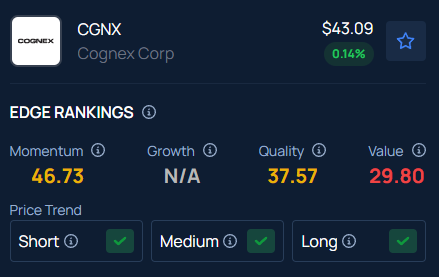
Photo Courtesy: StockPhotos.GALLERY on Shutterstock.com
Disclaimer: The content of this article solely reflects the author's opinion and does not represent the platform in any capacity. This article is not intended to serve as a reference for making investment decisions.
You may also like
Intel CEO: CPU only meets 50% of demand, 14A to start production in Q1 next year, new architecture may reduce inference power consumption to 1/15 of GPU
Intel CEO Pat Gelsinger stated that the era of AI agents has triggered an explosion in CPU demand, and Intel is currently able to meet only about 50% of its customers' supply needs, with several tech giant CEOs calling to secure supply. In terms of manufacturing process, the 18A node is now in full mass production, while the 14A node will begin production in the first quarter of next year. By opening up factory data, yield rates are improving by about 7% annually. Additionally, he is advancing neuromorphic computing to address energy consumption bottlenecks and expects quantum computing to have a substantial industrial impact within 3 to 5 years.
Reportedly, the US urges Japan to "increase" defense spending; Tokyo considers a 3.5% GDP target, bond market and yen come under pressure first
Under pressure from the United States, Japan is considering setting a new medium-term defense spending target, planning to increase its defense expenditure to 3.5% of GDP to align with NATO and other U.S. allies.

The logic of "cheap yen financing" is changing! Funds are reallocating "carry trades" as Swiss franc and Swedish krona compete for the funding currency position
The appeal of yen financing has diminished, and carry traders have recently turned their attention to the franc and the krona. With the yen’s recent surge making it a less reliable investment option, currencies such as the Swedish krona and Swiss franc are becoming primary funding choices for carry trades.

Crypto prices
More


