
Berachain hard fork to replace dual-token model with WBERA rewards

Berachain is preparing a hard fork that will replace its dual-token incentive model with one centered on its main BERA token.
Set for Wednesday at 4 pm UTC, the hard fork will end Bera Governance Token (BGT) emissions and shift the network's incentive system to Wrapped BERA (WBERA), the Berachain Foundation announced in a Tuesday X post.
Following the upgrade, the network will distribute fixed amounts of WBERA instead of BGT as block rewards. The change replaces Berachain's previous dual-token model, which split the network's functions between the transferable BERA token and the non-transferable governance token BGT.
Berachain said annual percentage rates (APR) could triple after the upgrade, though it warned yields may fluctuate during the first few days.
Berachain Foundation strives for a “simpler” token economy
The Berachain Foundation said the upgrade replaces its BGT-based reward system with one centered on sWBERA, the staked version of WBERA, which it described as simpler and more sustainable.
Before the upgrade, users seeking higher yields had to navigate multiple reward mechanisms and liquid staking tokens tied to BGT.
The transition will occur in two stages. WBERA emissions began Tuesday, while Wednesday's hard fork will halt BGT emissions.
Reward vaults and liquid staking incentives tied to BGT will be phased out in the days following the hard fork.
Related: Solana Foundation launches framework for protocol-level governance
BERA falls 7% ahead of hard fork as network activity remains muted
The BERA token fell 7% in the 24 hours to 8:34 am UTC, extending its decline over the past year to 88%, according to CoinMarketCap.
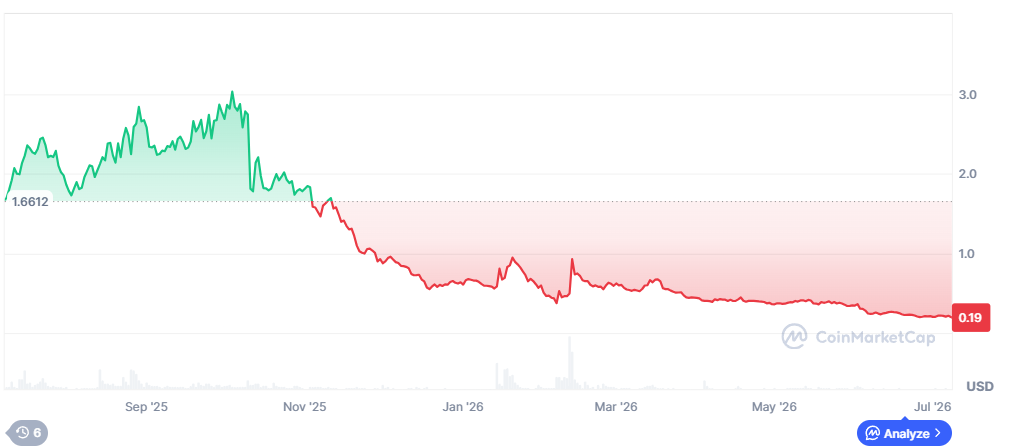
BERA/USD, 1-year chart. Source: CoinMarketCap
Berachain's total value locked (TVL) fell by $1.79 million, or 3%, over the same period. The network ranks 37th by TVL with $56 million locked, according to DefiLlama. Over the past 24 hours, Berachain generated $41 in chain fees and $3,359 in application revenue while distributing $14,816 in token incentives.
Magazine: Has Bitcoin bottomed for this cycle? Analysts say 'not yet'
Disclaimer: The content of this article solely reflects the author's opinion and does not represent the platform in any capacity. This article is not intended to serve as a reference for making investment decisions.
You may also like
The Collapse of "Consensus Trading" and the Birth of a New Consensus! Goldman Sachs Explains: Why Institutions Are Currently Significantly Reducing AI Holdings
The extremely crowded trade of "going long on AI, short on everything else" is undergoing a painful unwinding—markets are no longer satisfied with the "burn rate narrative." Mega-scale cloud providers must deliver real, visible revenue conversions alongside $1.1 trillion in capital expenditures. A power gap of 40-50 gigawatts, rising capital costs, and a macro paradigm shift from an era of "overspending" are turning AI trades from a matter of faith into a harsh test of monetization.
Starknet TVL crashes 3.7x to $42M after getting 93% vote to become L1
Pundit to XRP Holders: Listen to This SWIFT Interview With Finextra Research

AI Capital Expenditure Faces a Dilemma: Accelerating Puts Pressure on Cash Flow, Slowing Down Undermines the Growth Narrative
Nomura Securities believes that the AI investment narrative is mired in an internal contradiction: if hyperscale cloud providers accelerate capital expenditures, their free cash flow will continue to be drained, raising doubts about the sustainability of financing; if they slow down, it would indicate a loss of confidence in AI demand and profitability expectations. Both paths lead to sell-offs. The crowded long positions accumulated during the AI agent boom in September have triggered large-scale stop-losses under negative catalysts, spreading to US Treasury bonds, exchange rates, and commodity markets, resulting in systemic deleveraging.
Crypto prices
More


