
The buying momentum for gold is rapidly fading

Since late May, under the combined impact of the Federal Reserve’s tightening expectations and repeated outbreaks of the Iran-Israel conflict, London gold has declined further, retreating to around $4000/oz. Meanwhile, there have been significant shifts in institutional behavior within the gold market, as we observe a rapid ebbing of buying strength.
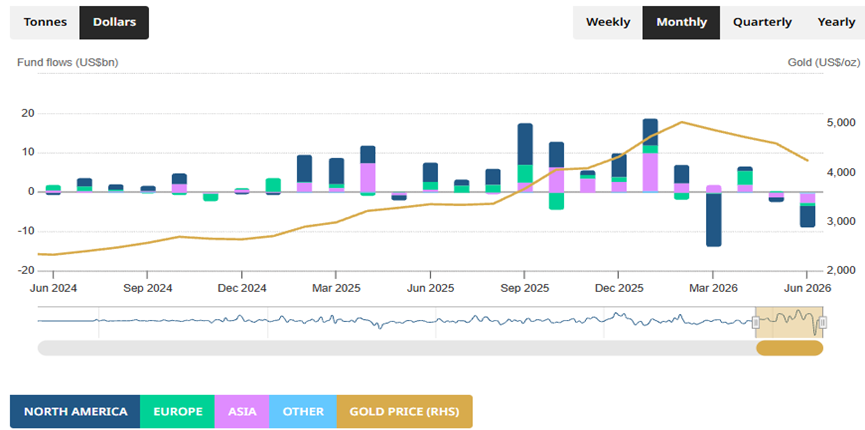
This trend has been led by overseas markets that were already less interested in gold. According to the World Gold Council, in June, global gold ETF net outflows reached $8.9 billion (74 tons), the second highest monthly outflow on record.
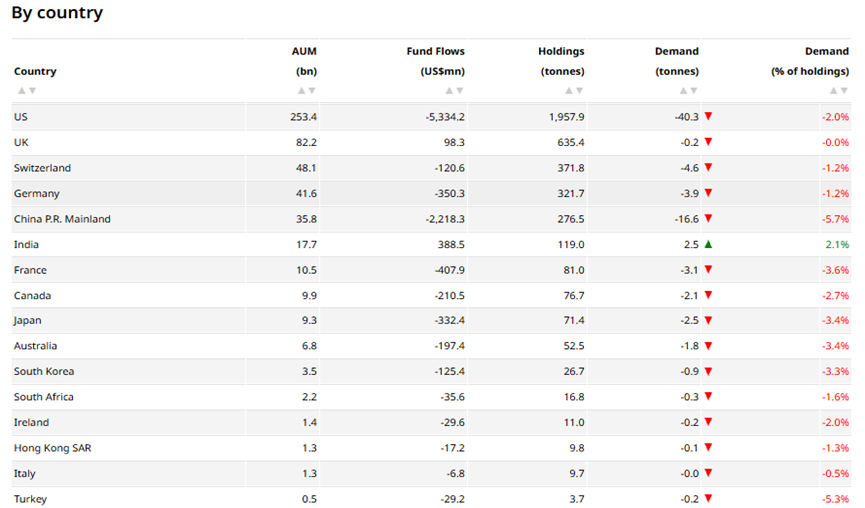
In March, global gold ETFs saw a record net outflow of $11.7 billion in a single month, but at that time, only the United States was the main seller (-$13.5 billion), while investors in Europe and Asia generally held steady or even increased their gold ETF holdings. However, in June, all three major markets—North America, Asia, and Europe—experienced net outflows. By country, with the exception of India, where investors increased their gold ETF holdings by $400 million, all other countries, including the United States (-$5.3 billion), Germany (-$400 million), France (-$400 million), Japan (-$300 million), and Canada (-$200 million), saw investors reduce their gold ETF holdings without exception.
Compared to the primarily US-driven sell-off due to equity market liquidity shocks in March, this round of gold selling is clearly broader in scope. This demonstrates that, amid a high real interest rate environment, speculative funds worldwide are accelerating profit-taking and reducing long exposure to gold.
June saw the second largest monthly net outflow from global gold ETFs in history
In June, most countries recorded net outflows from their gold ETFs
The domestic market has also confirmed this sentiment shift. An important signal is that, in June, China’s gold ETFs saw a significant reduction of 17.1 tons to 276.8 tons due to net outflows from subscriptions and redemptions, marking the largest single-month net outflow in history.
Since 2026, domestic investors have played a supporting role in buying the dips in the gold market. In February, March, and April, after significant gold price corrections, domestic gold ETF holdings did not decrease but instead increased, as a large number of investors opted to buy the dips. However, starting from late May, with rising expectations for interest rate hikes, capital began to flow out of domestic gold ETFs, and after the gold price fell below the 200-day moving average in early June, outflows accelerated significantly.
The weak price trend, lackluster rebound, and the appreciation of the RMB resulting in a greater decline for domestic gold compared to overseas gold, means the previously persistent domestic bottom-fishing buyers are obviously no longer able to support the market.
Since late May, domestic gold ETF holdings have rapidly declined
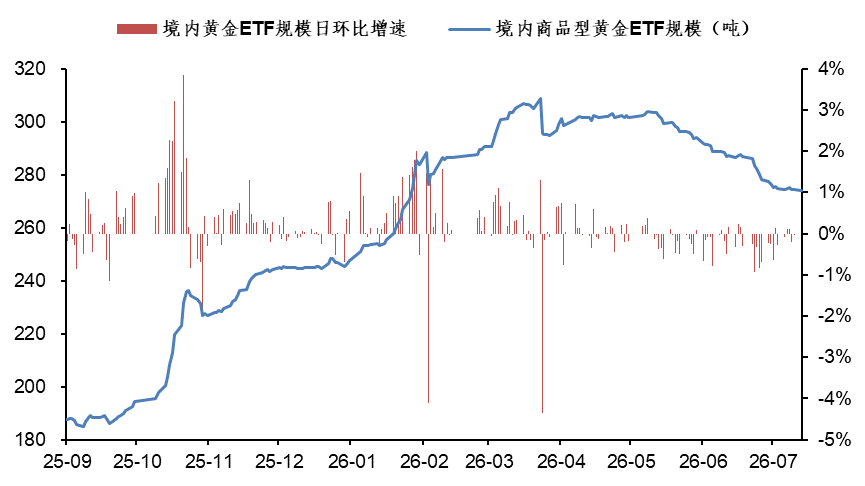
Looking at the scale of domestic gold ETFs, October 2025 and January-March 2026 were two periods of rapid expansion. The corresponding London gold price ranges were $3900-$4400 and $4600-$5600, both of which were mostly higher than the current price of London gold. Given that many individual investors who entered the market at higher price levels are more inclined to reduce holdings on rebounds, this will also limit the extent of price rebounds.
Finally, in contrast to the withdrawal of ETF funds, central bank gold purchases continue to act as a stabilizing force in the gold market. According to the World Gold Council, in May, global central banks made net gold purchases of 41 tons, with marginally stronger buying, led by Poland (+18 tons), China (+10 tons), and Uzbekistan (+9 tons). Preliminary June data indicates that the People’s Bank of China increased its gold holdings by 15 tons, with marginal growth in scale. Although central bank gold buying provides some medium-term support for gold, it alone is unlikely to drive a true rally or reversal in prices.
Global central banks saw consecutive months of increased gold purchases in April and May
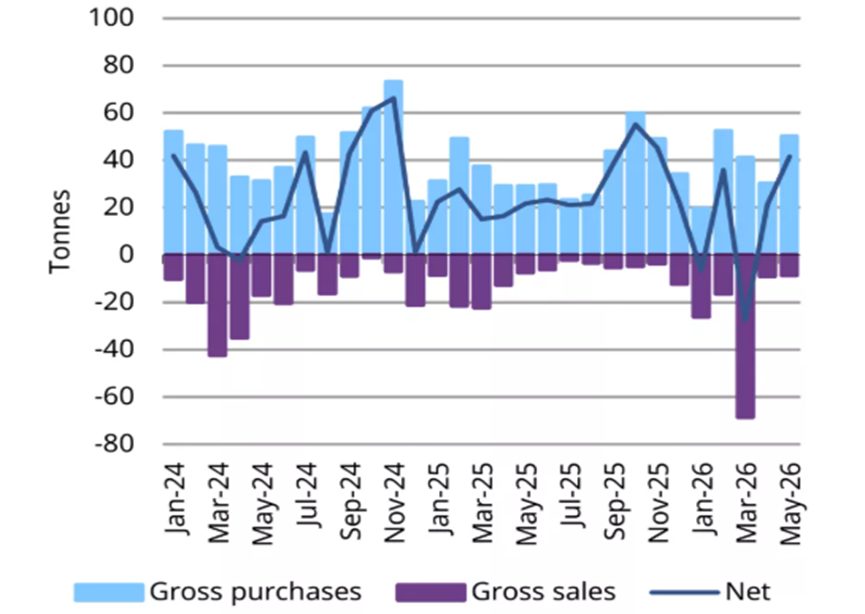
Overall, since late May, the gold market has shown a pattern of "position traders staying put, while speculators lose interest," with both domestic and foreign buying forces retreating significantly, resulting in waning market enthusiasm and discussion. Looking ahead, unless there is a reversal in hiking expectations, gold is likely to remain rangebound in the short term, and a breakout in the trend will be difficult to achieve.
BFC Hui Tan
With you in 2026
Welcome to leave us a message
Contact us for exchanges
Disclaimer: The content of this article solely reflects the author's opinion and does not represent the platform in any capacity. This article is not intended to serve as a reference for making investment decisions.
You may also like

Australian Dollar declines to near 0.7150 as hot US inflation data boost case for Fed rate hike
The AI super bull market still has room for imagination, but Wall Street has quietly prepared "two types of insurance": to guard against slow declines eroding returns, as well as to protect from sudden crashes.
Due to rising interest rates and oil prices causing the stock market rally to stall, investors are divided—some worry about a rapid sell-off, while others are concerned about a slow market decline. Some traders have become more creative with bearish strategies, such as buying put options on the Chicago Board Options Exchange Volatility Index or the S&P 500, or using double binary options to bet on a gradual price drop.

Sui trades near $0.72 as TD Sequential flashes buy signal, support zone in focus
Crypto prices
More


