
July 22 Financial Morning Brief: Fed officials reinforce hawkish expectations, gold price rebounds aiming for 4100, Trump threatens to strike Iran’s Gachsaran nuclear facility, oil price rebounds nearly 3%

Huitong Network, July 22—— In early Asian trading on July 22, spot gold was hovering near $4,084/oz, supported by rising hawkish expectations from Federal Reserve officials and a resurgence of tariff-hedging sentiment; US crude traded near $84.74/barrel, with oil prices rebounding on Tuesday as Middle East tensions persisted, intensifying concerns over ongoing logistics disruptions, especially the risk of further impediments to Saudi exports to Asia or Red Sea shipping.
In early Asian trading on Wednesday (July 22 in GMT+8), spot gold traded near $4,084/oz, buoyed by hawkish expectations from Federal Reserve officials and a resurgence of tariff-hedging sentiment; US crude hovered around $84.74/barrel, rebounding nearly 3% on Tuesday. Tensions in the Middle East persisted, aggravating market concerns about continued logistics disruptions, especially the risk of further impediments to Saudi exports to Asia or Red Sea shipping.
Key Focus of the Day
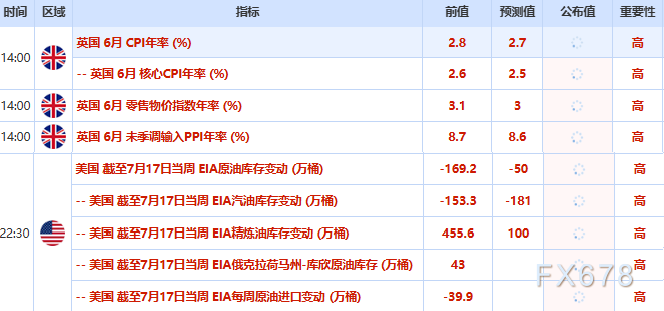
Stock Market
Main US stock indexes closed higher on Tuesday, with the Nasdaq leading the way with a 1.29% gain. The Dow Jones and S&P 500 rose by 0.74% and 0.89%, respectively, driven mainly by a strong rebound in semiconductor stocks. The Philadelphia Semiconductor Index closed up 5.2%, rising for the second consecutive day as investors rotated back into chip stocks ahead of big tech earnings to avoid missing out, though analysts warn that if stocks surge ahead of results, further upside may be limited.
Despite US President Trump announcing a new 50% tariff on Canadian imports and mounting Middle East tensions as Houthi threats to Red Sea shipping pushed oil prices higher, market reaction remained muted, with focus shifting to upcoming earnings reports from Alphabet, Intel, and Texas Instruments. Among S&P 11 sectors, information technology outperformed with a 2.35% gain, while consumer staples and communication services fell by 1% and 0.85%, respectively. On the individual stock front, 3M surged 7.3% after raising its full-year profit outlook, Hasbro soared 8.8% on boosted revenue and profit forecasts, while Danaher plunged 11%—the biggest S&P loser—after cutting its core revenue growth projections and disappointing in biotechnology, and MSCI, despite beating quarterly revenue estimates, tumbled 10% after raising its full-year expense outlook, becoming the index’s second-biggest decliner.
Gold Market
Gold prices rose nearly 2% on Tuesday, with spot gold settling 1.75% higher at $4,086.71/oz, mainly buoyed by expectations that Middle East conflicts could ease—a senior Iranian official revealed that Tehran had received a ten-day truce proposal from mediators. Should diplomacy achieve a breakthrough, concerns about energy supply disruptions may recede and expectations for Fed hawkishness could moderate.
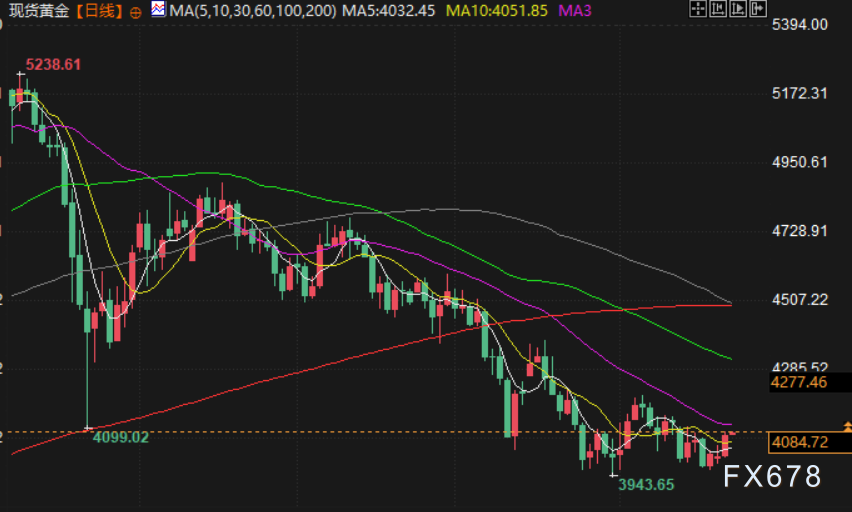
Marex analysts pointed out that gold also received technical buying support after breaking above its short-term downward trend line and may remain in a trading range in the near term; however, investors are still eyeing geopolitical developments and next week’s Fed policy meeting, with Chair Walsh’s speech and the rate decision seen as critical. The latest CME FedWatch tool shows traders pricing in a roughly 68% chance of a September rate hike.
Other precious metals also climbed, with spot silver surging 4.21% to $58.80/oz, and platinum and palladium gaining 1.9% and 2.4%, respectively.
Oil Market
Oil prices rose nearly 3% on Tuesday, with Brent crude settling at $91.36/barrel and US crude at $84.54/barrel, both marking their highest closes since June 10 and 11, driven mainly by escalating Middle East tensions.
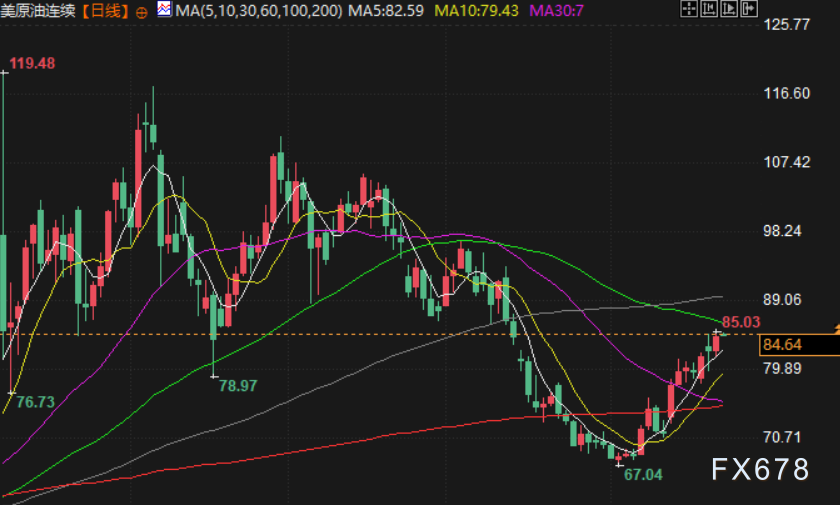
US forces bombed targets in southern and western Iran, while Tehran struck American installations in Bahrain, Kuwait, and Jordan. At least one oil tanker was attacked in the Strait of Hormuz, while Yemen’s Houthi forces threatened to blockade the Red Sea, causing two Saudi oil-laden tankers bound for Asia to turn back in the Red Sea, though sources said Yanbu Port continued normal operations. Analysts note this rally was not due to actual immediate supply losses but rather intensifying concerns about continued logistics disruptions, particularly the threat of further blockages to Saudi exports to Asia or Red Sea shipping.
Brent crude entered a technical overbought region for the seventh consecutive trading day—the first time since June 2025. JODI data showed Saudi crude exports fell for a third month in May to record lows, and the Caspian Pipeline Consortium (CPC) has suspended receiving Kazakh oil after a Black Sea terminal was attacked. The market is now awaiting the US EIA’s weekly inventory report; analysts predict a 500,000-barrel drop in crude stocks for the week ending July 17, which would mark a second consecutive weekly decline.
Forex Market
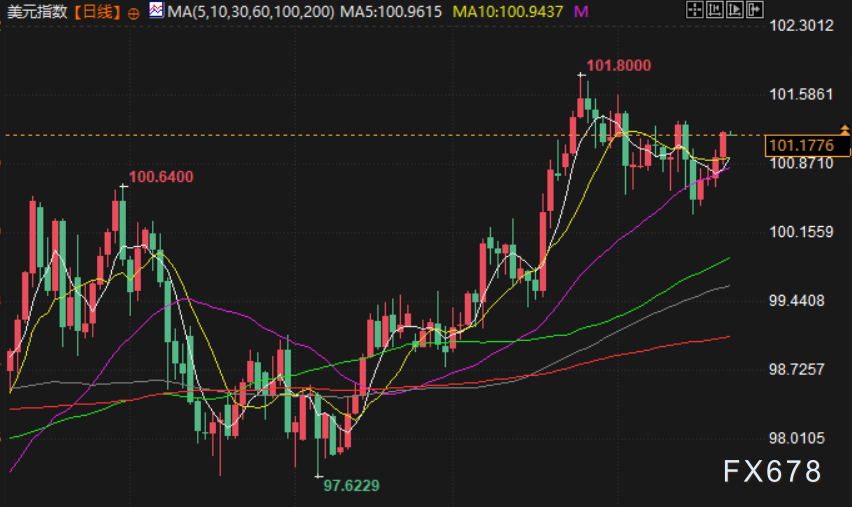
The US dollar index rose 0.25% on Tuesday to 101.20, climbing for the fourth consecutive session, driven primarily by surging oil prices on the back of the latest Middle East strikes, which heightened persistent inflation concerns. Multiple Fed officials, including Chair Walsh, also voiced worries about inflationary pressures, reaffirming hawkish expectations.
CME FedWatch shows the probability of at least a 25-basis-point hike at next week’s meeting ticking up to 21.9%, while the likelihood of a hike in September stands at 68.2%. Although Iran has received a 10-day ceasefire proposal from mediators and diplomatic efforts continue, US President Trump threatened to respond to Houthi blockade actions, leaving geopolitical risks unresolved.
Among major currency pairs, the euro slipped 0.11% to $1.1402 against the dollar, the British pound dipped 0.39% to 1.3376—its fourth straight daily decline—as investors assessed the outlook for higher UK government spending under new Prime Minister Burnham and funding plans by new Chancellor Healey, while UK labor market data showed limited wage pressure.
The Japanese yen briefly broke the 163 mark, trading at 162.42 per US dollar for the first time since December 1986, as traders stayed alert to possible Japanese government intervention; the Canadian dollar fell 0.27% to 1.411 per US dollar, retreating from a one-month high after the US imposed a new 50% tariff on Canadian products. Markets also looked ahead to the European Central Bank’s meeting later in the week, where rates are expected to be kept unchanged, though at least one more hike is still possible later this year.
International Headlines
According to CME “FedWatch”: There is a 74.9% chance that the Fed holds rates unchanged in July, with a cumulative 25-basis-point hike probability at 25.1%. By September, the probabilities for holding, a cumulative 25-bp hike, and a cumulative 50-bp hike are 28.9%, 55.7%, and 15.4%, respectively. By December, the probabilities are 12.8% for no change, 37.4% for a 25-bp hike, and 50% for at least a 50-bp hike.
Chicago Mercantile Exchange Group announced Tuesday that it plans to launch new sorghum basis futures contracts on August 24, pending regulatory approval. These contracts are designed to provide market participants with tools to manage price basis volatility between physical sorghum and corn futures. Sorghum, a drought-tolerant grain mainly grown on the US Plains, is used similarly to corn for animal feed and biofuel, typically priced at a premium or discount relative to the CME’s main corn contract. Volatility in this spread has intensified in recent years, frequently swinging between large premiums and deep discounts. The contracts will be physically delivered, with delivery points at multiple warehouses across Kansas—the number one producing region—with shipments via truck or rail. The global head of ag products noted this tool would help farmers, traders, and exporters effectively hedge basis risk.
According to The Jerusalem Post citing two sources, the current US-Iran 10-day ceasefire proposal, now under mediation, was initially tabled by Tehran, highlighting Iran’s sense of urgency for a truce. The idea is to buy time for negotiations over the Strait of Hormuz. Mediators, including senior officials from Qatar, Egypt, Oman, and Pakistan, have submitted the proposal to the US side, suggesting the creation of a “transit corridor” to ensure merchant vessel safety. The US wants to extend the ceasefire period, insisting on at least a partial agreement on freedom of passage before the truce takes effect, with remaining details to be settled within ten days. However, some Trump administration officials called the Iranian proposal “absurd,” and one US official said Trump still wants Iran to “pay a price” for previous MOU violations and causing US personnel deaths.
In the early hours of July 22 local time, Iran’s Khatam al-Anbiya Central Command issued a statement declaring that if the US military attacks Iran’s nuclear facilities and sensitive centers, Iran will treat it as an expansion of regional war, and all US and allied interests in the region will become targets for strong Iranian military retaliation. The US plans to impose new tariffs no later than Friday to replace soon-to-expire temporary 10% global tariffs. According to informed sources, President Trump is preparing to impose new tariffs on goods from dozens of economies by the end of this week. This move intends to keep the tariff regime intact even after the temporary 10% global tariffs expire. The Trump administration last month proposed at least a 10% new tariff on 60 trading partners over concerns about forced labor. Sources said the president’s team is ready to implement these duties by week’s end, though the final rate could change from the original plan.
New UK Prime Minister Andy Burnham has approved US use of British military bases for what the UK terms defensive action against Iran; despite President Trump ramping up US military action, Burnham maintains former PM Starmer’s policy. Insiders say Starmer chaired a meeting of senior ministers and officials last Friday to review the UK’s position following the US resuming actions earlier this month. Attendees decided to continue allowing US military aircraft use of Diego Garcia in the Indian Ocean and RAF Fairford in Gloucestershire, England, to counter Iranian missile threats and attack sites targeting the Strait of Hormuz.
US President Trump said on July 21 at the White House during a meeting with visiting Lebanese President Aoun that the US will take action should Yemen’s Houthi rebels blockade the Red Sea. On the Houthi threat, Trump noted nothing had happened yet—“If it really happens, we will act and handle it.” On July 20, the Houthis declared a “maritime embargo” on Saudi Arabia, effective immediately. The Saudi-led coalition later announced measures to secure member state vessels in the Bab el-Mandeb and vowed to firmly respond to any Houthi threat. On Lebanon, Trump expressed a willingness to talk with Hezbollah and will discuss aid and coordination with Aoun and other parties. (Xinhua News Agency)
US President Trump told the media on July 21, during a White House meeting with visiting Lebanese President Aoun, that the US will “soon” strike Iran’s fortified underground “Haoshang” site south of Natanz, and that the attack will be “very fierce.” “Haoshang” is a reinforced underground facility. Iran declared to the IAEA in 2020 that the site would be used for assembling centrifuges for nuclear fuel production. Trump last week also said in an interview that the US “may act on ‘Haoshang’ soon.” Some reports indicate that after the 12-day Iran-Israel conflict ended in June last year, Iran moved advanced centrifuges and some highly enriched uranium stocks to this underground facility. (CCTV International News)
On July 21 local time, Canadian Prime Minister Mark Carney said he had spoken by phone with US President Trump following the US tariff announcement. Carney said if the new tariffs take effect, Canada will consider all options in response. The White House announced on July 20 that the US will impose an additional 50% ad valorem tariff on certain Canadian products in response to “Canada’s discriminatory measures on US auto and auto parts trade.” A White House factsheet listed tariffs on wine, hockey sticks, and cement from Canada—even if these products conform to the US-Mexico-Canada Agreement. The White House said the tariffs are intended to offset the burden and disadvantages to US business caused by Canadian discrimination, with the new measures taking effect August 19 EDT. (CCTV News)
Domestic Headlines
On July 21, the National Energy Administration released the “China Oil & Gas Exploration and Development Report 2026”, showing that in 2025, China’s crude oil output will hit a record high of 216 million tons, natural gas output will exceed 10 billion cubic meters growth for the ninth straight year, total oil and gas production equivalent will reach a new high of 420 million tons, and self-sufficiency has significantly improved. Progress has also been made in oil and gas technology innovation, upstream reforms, and low-carbon transition. (CCTV News)
Disclaimer: The content of this article solely reflects the author's opinion and does not represent the platform in any capacity. This article is not intended to serve as a reference for making investment decisions.
You may also like
Dogecoin forms falling wedge, eyes $0.150 target as derivatives activity rises
Crypto market’s weekly winners and losers – VVV, LSK, ARB, ENA
Algorand eyes $0.10037 resistance as buyers defend key support
Nu digital bank launch expands into the U.S. with 3.50% APY accounts
Crypto prices
More


