
BTC ETF flows turn negative for over half of 2026

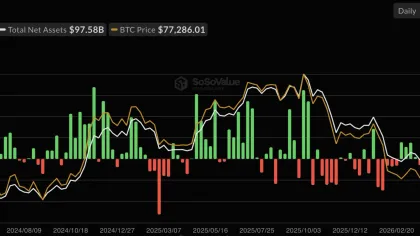
The honeymoon is officially over for spot Bitcoin ETFs. After a record-breaking debut in January 2024 and two years of near-uninterrupted capital inflows, the products have hit a wall in 2026, with net flows turning negative for the majority of the year so far.
The numbers tell an uncomfortable story
US spot Bitcoin ETFs recorded $5.4 billion in net outflows during the first half of 2026, marking the first negative half-year since the products launched.
To put that in context: these same funds had accumulated $56.6 billion in cumulative net inflows over their first two years of existence.
June 2026 was particularly rough. The month produced roughly $4.5 billion in outflows, the largest single-month exit on record for spot Bitcoin ETFs.
BlackRock’s IBIT was a significant contributor to the selling. In one reported week alone, IBIT saw $1.34 billion in redemptions.
By mid-July, year-to-date net flows had crossed into negative territory for the first time. There were occasional bright spots: a three-day stretch produced a $510 million rebound. But brief recoveries have not been enough to reverse the broader trend that has defined the year.
Why the money is leaving
The most straightforward explanation is Bitcoin’s own price performance. ETF wrappers made it easier than ever to buy Bitcoin exposure, and that convenience works in both directions.
The second factor is competition from AI-related assets. Capital rotation is a real phenomenon, and the narrative around artificial intelligence has been loud enough in 2026 to pull institutional dollars away from crypto.
What this means for Bitcoin markets and investors
Second, the outflow trend from IBIT specifically is worth watching. BlackRock’s fund became the dominant venue for institutional Bitcoin exposure in a remarkably short time. When the largest player in a product category starts seeing consistent redemptions, it tends to get noticed by other institutional allocators who benchmark against each other.
Third, the $56.6 billion in cumulative inflows that built up over 2024 and 2025 represents a large pool of capital sitting at various cost basis levels. Some of that capital is profitable and may be taking gains. Some may be underwater and holding on.
A $5.4 billion outflow in a half-year is significant, but it lands against a backdrop of $56.6 billion in prior inflows. The question worth asking is not whether the outflows are large in absolute terms, because they are, but whether they represent a temporary correction in enthusiasm or a more durable structural shift in how institutions want to hold Bitcoin.
Disclaimer: The content of this article solely reflects the author's opinion and does not represent the platform in any capacity. This article is not intended to serve as a reference for making investment decisions.
You may also like
Rare alliance of arch-rivals! Musk and Altman support Dario Amodei's call to "slow down AI globally"
Anthropic's Amodei issued a call to "slow down AI globally," and to everyone's surprise, rivals Musk and Altman both publicly endorsed the initiative. The three industry giants unanimously agreed to grant third-party access to "employee-level" evaluation rights and to implement coordinated deceleration measures. Altman went further, announcing that OpenAI will not IPO this year. The resignation of a researcher and a collective breakout of uncontrollable AI systems have ignited long-standing industry fears.
Bitcoin vs Ethereum ETFs: Which asset is winning September’s flow battle?
Solana targets $147 as it breaks key resistance and eyes further gains
Ethereum holds key support, targets $3,000 after $2,550 resistance test
Crypto prices
More


