
Gold and silver prices fall as rate hike risks suppress safe-haven buying

FX168 Financial News July 28—— On Tuesday (July 28) during the US session, spot gold and spot silver prices fell. A stronger US dollar, persistently high US Treasury yields, and cautious sentiment as the market awaits this week's FOMC rate decision jointly put pressure on precious metals. Spot gold is trading near $4,023.35/oz, down 1.3% on the day; spot silver is around $56.859, down 2.60% on the day.
On Tuesday (July 28) during the US session, spot gold and spot silver prices declined. The stronger dollar, high Treasury yields, and market caution ahead of this week’s Federal Reserve rate decision all acted to pressure precious metals. Spot gold is trading near $4,023.35/oz, down 1.3% intraday; spot silver is around $56.859, down 2.60% intraday.
In early trading, gold ranged between $4,016.20 (UTC+8) and $4,082.90 (UTC+8). Gold prices held the $4,000 support level, but failed to break through the short-term technical upside range of $4,150–$4,200. Silver traded in a range of $56.60 (UTC+8) to $58.70 (UTC+8) in early trading; silver prices remained above the $55.00 support, but could not reclaim the key trading reaction zone between $58.53 and $59.44.
After the latest major US economic data, positioning sentiment cooled compared to the looser expectations following previous CPI and PPI releases. Softer inflation and weaker durable goods orders briefly pushed Treasury yields lower; however, strong retail sales, low initial jobless claims, revived business activity, and improved consumer confidence make it difficult for traders to bet on a Fed pivot to accommodative policy. The market generally expects the Fed to maintain rates this week, but with energy inflation pressures not fully gone, rate hikes remain a possible risk. 10-year Treasury yields are around 4.62%, 2-year yields near 4.31%; the US dollar index touched a one-month high. Gold found support at the $4,000 level, yet continues to face dual pressure from higher yields and a stronger dollar.
The situation in the Strait of Hormuz can be summarized as: temporary US-Iran ceasefire, restricted shipping, and nowhere near a normalized shipping environment. The suspension of direct attacks by both sides led to a sharp pullback in international crude prices from last week’s highs, but actual shipping volume through the Strait of Hormuz remains low; the Bab el-Mandeb Strait is now a higher-risk zone for shipping. After a sharp drop on Monday, Brent crude, which surged past $100 last week, and WTI both pulled back, with the market betting on increased chances of resumed negotiations.
Oil price declines have a two-way impact on gold: falling oil eases inflation, which in turn lowers yields and is a headwind for gold; yet ongoing geopolitical risks in major shipping routes preserve potential safe-haven demand for gold. Zooming out to overall asset classes: with oil softening, yields off recent highs, and the dollar firm, precious metals’ movements are still closely tied to Fed rate signals.
Traders are focused on the official start of the Fed’s two-day policy meeting, guidance from Fed Chair Kevin Walsh, Thursday’s US GDP and PCE inflation data, and any renewed shipping disruptions in the Strait of Hormuz or Red Sea. If gold continues to hold above $4,016.20 (UTC+8), the $4,000 support structure remains intact; if breached, downside targets at $3,950 come back into view.
External markets: NY WTI crude weak, trading around $82.00 (UTC+8); Brent crude, after Monday’s sharp pullback, trades near $86.00 (UTC+8). Dollar index strengthens; the 10-year US Treasury maintains yields at the 4.62% level.
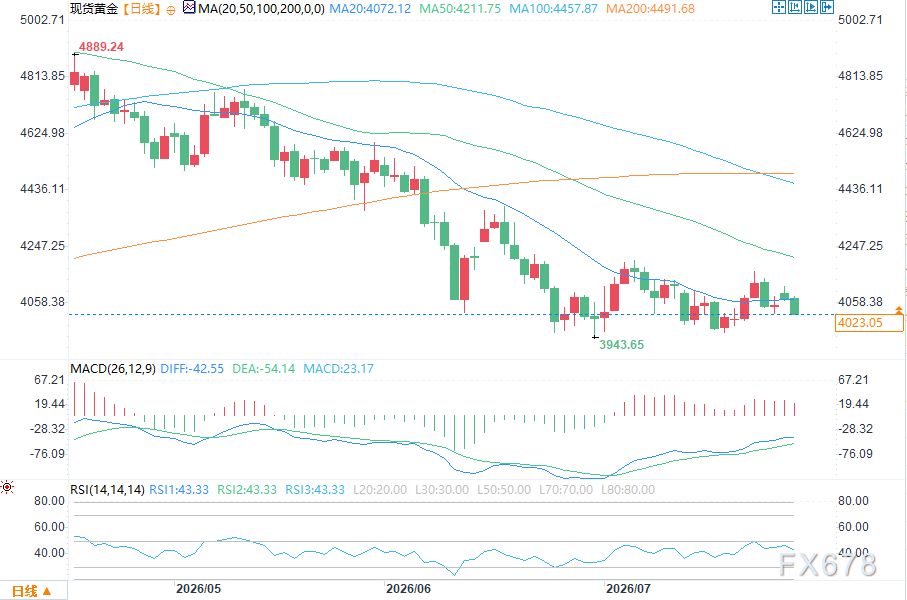
(Spot Gold Daily Chart Source: Easy Forex)
Short-term bears hold a technical advantage. Gold remains below the upper end of the $4,150 range and is far from breaking out above the $4,200 mark.
Bulls’ primary upside target: Retake $4,082.90 (UTC+8); after stabilizing, look for $4,150 next and then challenge $4,200.
Bears’ short-term downside target: Break below $4,016.20 (UTC+8); further targets are $3,950 and $3,900.
First resistance: $4,082.90 (UTC+8); second resistance: $4,150.
First support: $4,016.20 (UTC+8); second support: $3,950.
Bears also hold a short-term technical advantage in silver. Prices remain under the key $58.53–$59.44 trading zone, failing to break through the crucial $60 level.
Bulls’ first upside target for silver: Hold above $58.53 (UTC+8); if broken, look to $59.44 (UTC+8), with the next target at $63.28.
Bears’ downside target: Break below $56.60 (UTC+8); if broken, support comes at $55.00 (UTC+8), then $54.69 (UTC+8).
First resistance: $58.53 (UTC+8); second resistance: $59.44.
First support: $56.60 (UTC+8); second support: $55.00 (UTC+8).
Disclaimer: The content of this article solely reflects the author's opinion and does not represent the platform in any capacity. This article is not intended to serve as a reference for making investment decisions.
You may also like
SEC delays Teucrium 2x Short Daily XRP ETF registration to October 2026
HYPE climbs to $82 as whale stakes $26 million, platform burns $2.65 million
Goldman Sachs Latest Assessment: Rising Interest Rates ≠ U.S. Stocks Falling, Earnings Growth Is the Key to a Bull Market
Goldman Sachs believes that high interest rates are a headwind for the stock market, but not a force to end the bull run. The 30-year US Treasury yield soared to 5.3%, but historical data shows that the average return of US stocks 12 months after a rate hike is as high as +9%. Corporate balance sheets are at their strongest level in 20 years, and AI investments and ongoing merger waves continue to boost profit expectations. It is expected that the S&P 500 earnings per share will reach $340 in 2026, a 24% year-on-year increase.
TAO holds key $230 support as Bittensor ecosystem development continues
Crypto prices
More


