
The Real Significance of GPT-6 Astra: Bringing the "AI Narrative" Back from "Demand Debates" to "Physical Bottlenecks"

The release of a new model is shifting the direction of market debates.
For the past few months, the market has been debating one question: "How much infrastructure is really required to serve known AI demand?" The underlying implication: has AI infrastructure already been over-invested in?
However, according to ChaseWind Trading Desk, a report published by Morgan Stanley on September 7 points out that the importance of GPT-6 Astra should not be simply understood as yet another scaling narrative. This is not just another model upgrade.
Astra represents a substantive leap in the breadth of capabilities and interoperability, specifically in four directions: reasoning, engineering, computer usage, and real-world task execution. This means AI is crossing over to be able to conduct complex reasoning, undertake professional engineering duties, directly operate computers, and even handle tasks in the physical world. As AI can do more, its avenues for monetization also expand. OpenAI's latest article also mentioned that better models are opening up new "job domains".
AI Narrative Shifts Back from "Demand Debate" to "Physical Constraints"
The emergence of Astra may shift the market’s core question from “how much infrastructure is needed to serve known AI demand” to: “As model intelligence improves, how many new workloads will become economically viable?”
These are fundamentally opposite lines of questioning. The former is skepticism on the demand-side; the latter is pressure on the supply-side.
- Elasticity Effect: More Intelligence Per Dollar
Analysts in the report present a core economic logic: better models can generate an elasticity effect—when every dollar spent on AI delivers more intelligence and utility, the quantity, duration, and complexity of inference workloads increase accordingly.
This is similar to the classic "Jevons paradox": increased efficiency does not reduce consumption; instead, it expands total consumption. Rising output per unit cost of intelligence → previously unprofitable applications become viable → new workloads flood in → demand for compute and infrastructure actually expands.
- Addressable Market Expands Significantly
Analysts believe that if Astra's capabilities translate into commercially useful applications, the addressable AI revenue pool will expand dramatically, far surpassing today's primary use cases of chat and coding.
Morgan Stanley calculates the global knowledge work TAM at around $22.5 trillion (based on 900 million knowledge workers worldwide, with an average annual salary of about $25,200); consumer spending TAM is about $30 trillion, covering retail + travel (about $16 trillion), autonomous driving/mobility (about $4 trillion), food delivery (about $4 trillion), and advertising (about $3 trillion).
- Physical Supply Constraints Are the Real Bottleneck
Analysts conclude: the emergence of Astra shifts the bottleneck narrative from "demand formation" back to "physical supply constraints"—i.e., whether these intelligences can be delivered at scale.
What does this specifically refer to? Computing power. Electricity. Materials. Labor. Etc.
Where Are the Physical Bottlenecks: ABF and HBM4E
There are two concrete supply-side pinch points.
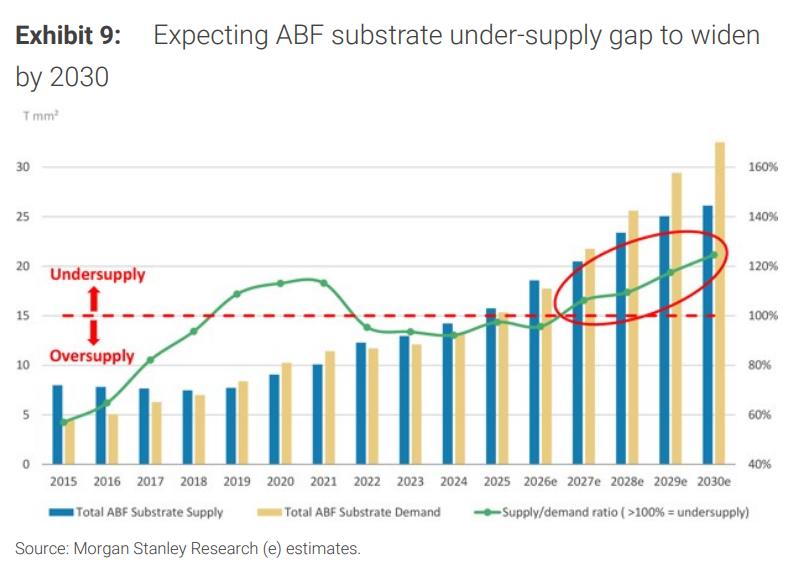
The first is ABF substrate.
Morgan Stanley expects ABF substrate shortage to emerge from 2027 on, with the gap continuing to widen through 2030. The key constraint: new capacity takes at least two years to come online.
The second is HBM4E's back-end-of-line (BEOL) complexity.
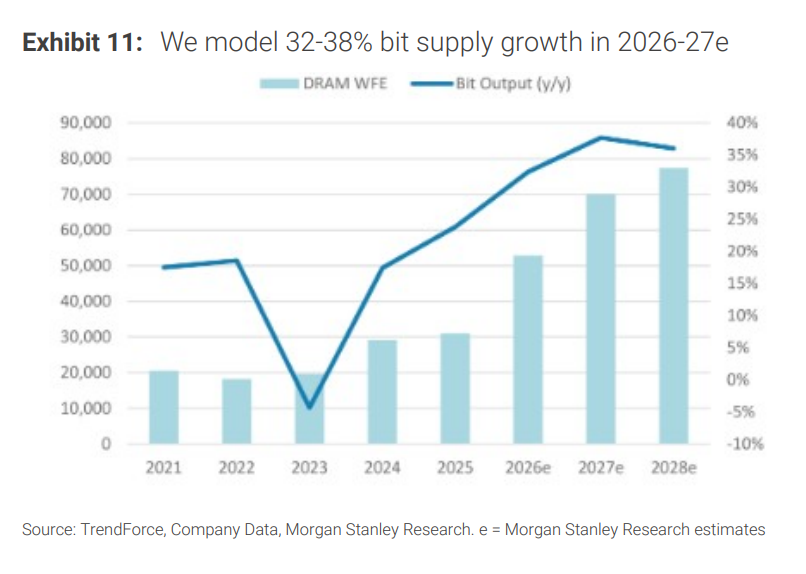
The report highlights that HBM4E’s back-end-of-line marks a major paradigm shift in semiconductor manufacturing—HBM is evolving from dedicated 3D memory stacks into highly integrated, custom Chiplet logic systems.
Specific impact chain:
- Number of HBM4E interconnect layers rises (e.g., SK Hynix introduces dummy bump), with substantial DRAM capex forced to focus on BEOL expansion
- FEOL node migration capex and DRAM GB shipments will accelerate, possibly not materializing until the second half of 2027
- DRAM vendors will allocate equipment capacity to themselves first, so NAND expansion may be delayed
The common feature of these two bottlenecks: both are verifiable and traceable physical constraints, not market sentiment.
Electricity: The Most Tangible Physical Bottleneck
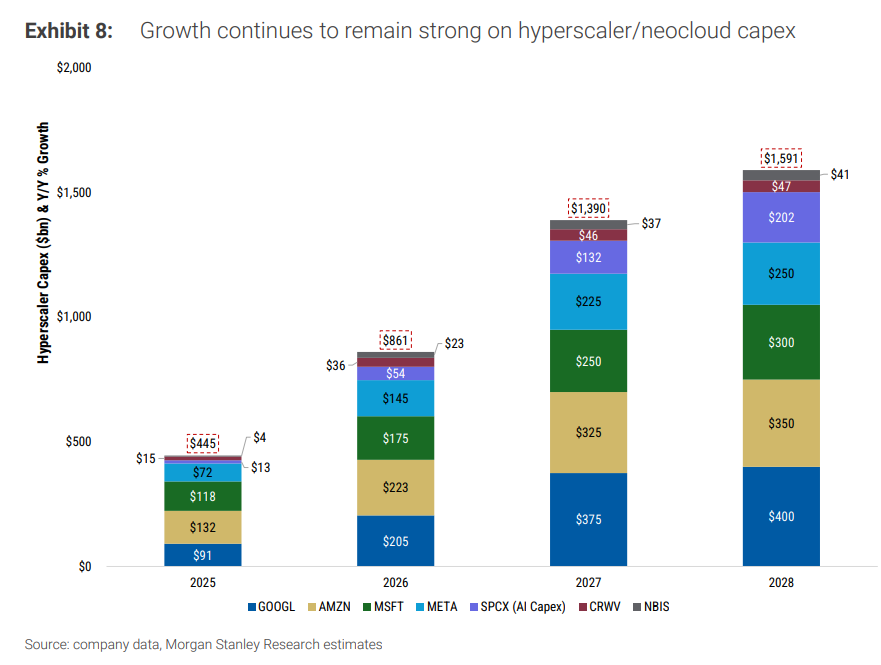
With increased regulatory pressure on data centers, power supply has become another key physical bottleneck. Analysts project that hyperscale cloud providers’ total compute capacity will grow from around 35GW in 2025 to about 145GW in 2028—a fourfold increase.
Analysts indicate the US faces a 38GW power deficit, and data centers will increasingly turn to behind-the-meter self-generation solutions.
The bank estimates that behind-the-meter power adds around $3 billion in capex per GW. For example, the all-in cost per GW for a generation of Nvidia’s Rubin Ultra chips, including behind-the-meter power, is about $5 billion.
What the Market Is Underestimating
Analysts believe the market is currently underestimating three aspects:
First, the global tech beneficiaries of GPT-6 Astra have not been fully priced in.
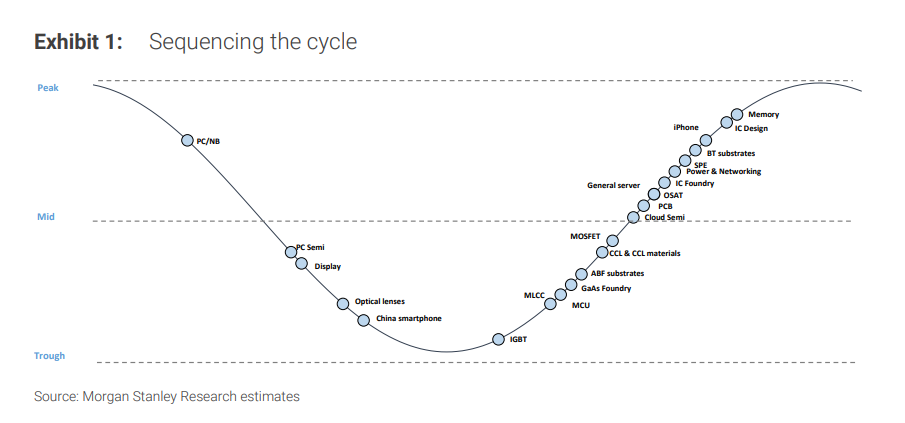
Second, supply tension may last longer. ABF and HBM4E BEOL constraints are not issues that can be resolved in the short-term.
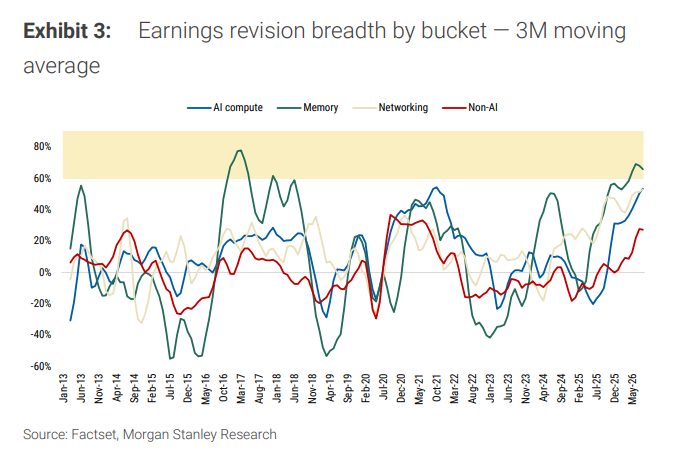
Third, some stocks that don’t rely on AI are quietly strengthening. Analog chips (STM, NXP, Renesas) have experienced an L-shaped bottom for over three years and are now in an early-cycle recovery stage—inventory reduction, price stabilization, and improved industrial orders.
The Conclusion Is Not “Buy More AI”
Morgan Stanley’s suggested investment priorities:
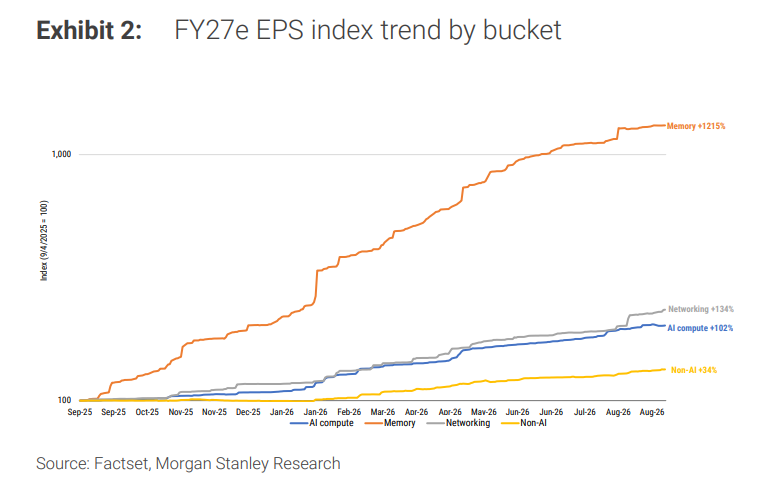
AI Compute (top priority) > Network (next) > Memory (selective) + Analog chips (early-cycle hedge), including:
- AI Compute: GPUs (Nvidia), ASICs (MediaTek, GUC), ABF substrates (Unimicron, IBIDEN), MLCCs (Murata, Samsung Electro-Mechanics), back-end testing and packaging (Advantest, Tokyo Electron, Wavetek, ASE, KYEC), power (Delta)
- Network: GLW, LITE, COHR, KEYS, Furukawa Electric, Fujikura
- Memory: Prefer structural share gain and localization (CXMT), SK Hynix, Samsung, Kioxia have tactical upside amid ongoing supply constraints
- Non-AI: Analog chips (STMicroelectronics, NXP, Renesas)
The bank stated: "We prefer to deploy to companies at the convergence of broader inference cycles, limited physical capacity, rising content intensity, and increasing manufacturing complexity."
Points to Remain Sober About
Morgan Stanley’s report is not one-sidedly optimistic, and explicitly points out three caveats to note:
First, AI expectations are already very high. The market's tolerance for AI companies has shifted from "good results" to "must be perfect results". Even if Astra brings substantive progress, if results don’t significantly beat expectations, share price reaction may still be muted.
Second, capex growth is expected to slow in 2028. Equity pricing depends on the rate of growth, and any slowdown may continue to weigh on valuations, even if the absolute value is still increasing.
Third, macro headwinds remain. The report mentions oil prices, inflation, the Fed's interest-rate trajectory, and the 2028 US presidential election as uncertain factors—especially noting possible political resistance to data center expansion if the Democratic Party wins executive power.
~~~~~~~~~~~~~~~~~~~~~~~~
The above content is from ChaseWind Trading Desk.
For more detailed analysis, including real-time interpretation and frontline research, please join [ChaseWind Trading Desk Annual Membership]

Disclaimer: The content of this article solely reflects the author's opinion and does not represent the platform in any capacity. This article is not intended to serve as a reference for making investment decisions.
You may also like
Pepe memecoin torn between Greed sentiment and falling market cap
Charles Schwab fund reports $4.8 million in XRP ETF collateral, XRP trades 60% below all time high
Gold Surges to $15,000: Fantasy, Prediction, or Warning?

QCOM: Can the Amazon Deal Unlock a Second Growth Engine?
Crypto prices
More


