
Bài phát biểu diều hâu của Powell giáng đòn mạnh vào kỳ vọng cắt giảm lãi suất, thị trường toàn cầu đối mặt với "cơn bão mới"!

 Powell trong buổi đối thoại với các lãnh đạo doanh nghiệp địa phương do Fed Dallas tổ chức cho biết: “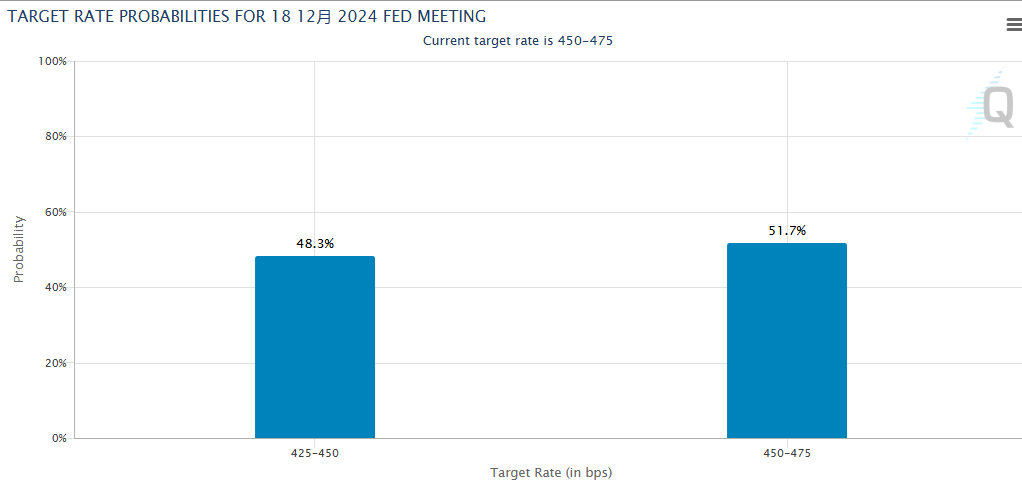
① Powell stated in his latest speech that the Federal Reserve is not in a hurry to cut interest rates in a strong economy; ② This hawkish rhetoric quickly stirred up a storm in the global market.
On November 15th, Caixin Media (Editor Xiaoxiang) reported that following the speech by Federal Reserve Chairman Powell in the early hours of Friday Beijing time, Powell stated that the Federal Reserve is not in a hurry to cut interest rates in a strong economy. This hawkish rhetoric quickly stirred up a storm in the global market.
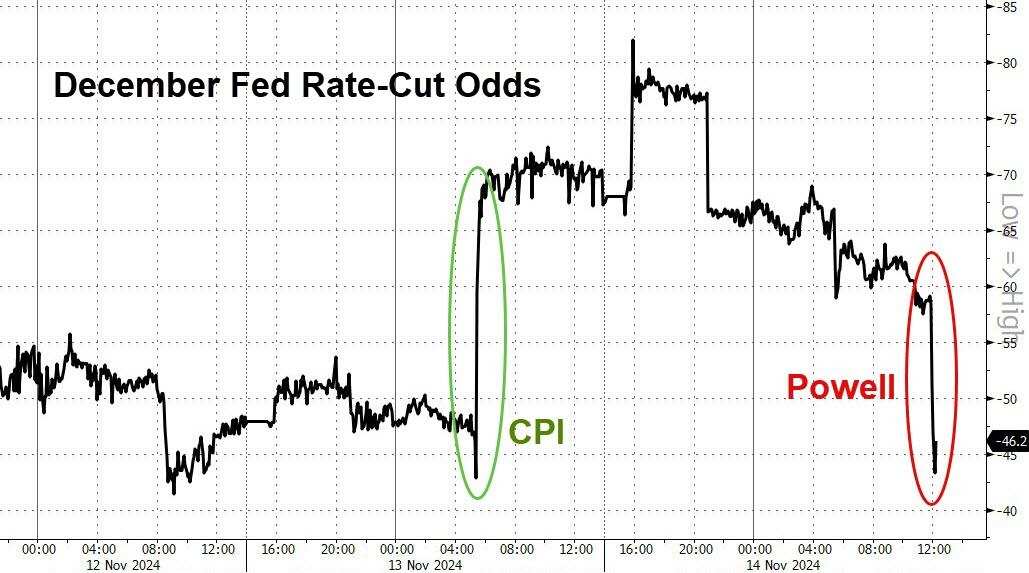
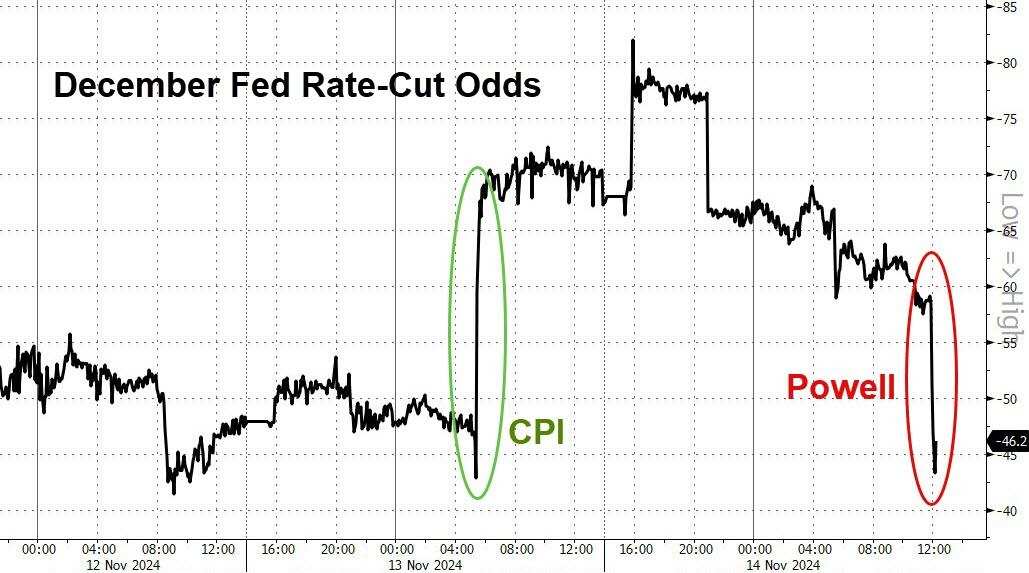
After Powell's speech, the US stock market closed near intraday lows, and the US dollar surged along with US bond yields, with the ICE US Dollar Index hitting a one-year high. Traders reduced the probability of a December rate cut from 80% the previous day to around 50%, sharply contrasting with the CPI release day before.
 During a dialogue with local business leaders hosted by the Dallas Fed, Powell said, "The economy has not shown any signals that require an urgent rate cut. A good economic situation gives us the ability to act prudently when making decisions."
Regarding inflation, Powell pointed out, "The inflation rate is getting closer to our long-term target of 2%, but has not yet been achieved. We are committed to this mission. With the labor market roughly balanced and inflation expectations well anchored, I expect the inflation rate to continue to trend towards the 2% target, albeit with some fluctuations."
To combat inflation, the Fed raised rates to the highest level in 20 years last year and then kept rates at that level for over a year to ensure that price pressures do not return. Since mid-2023, although US inflation has significantly decreased, the slowdown in price growth is sometimes uneven, including in the past two months.
Powell reiterated that the Fed's policy rate path will depend on upcoming data and the evolution of the economic outlook, closely monitoring core indicators of goods and services inflation, excluding housing, which have been declining over the past two years.
The Fed has cut rates in the last two meetings, first making a significant 50 basis point cut in September when there were signs that the labor market might be weakening. At the meeting last week, officials cut the benchmark rate again by 25 basis points to a range of 4.5% - 4.75%.
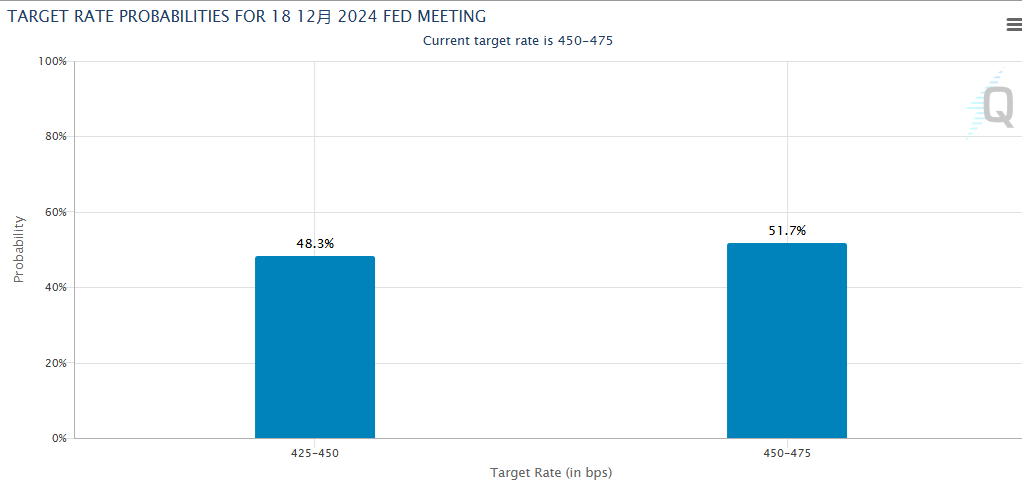
The next meeting of the Federal Reserve will be held on December 17-18. In his latest speech, Powell did not comment on the possibility of a rate cut at the December meeting. However, his remarks clearly dealt a significant blow to the market's expectations for a rate cut next month. The CME FedWatch Tool shows that the likelihood of the Fed achieving a third consecutive rate cut next month has once again become uncertain.
And market traders undoubtedly also quickly reacted to the news.
Global markets face a "new storm".
Most maturities of US Treasury yields rose after Powell's speech overnight, especially short-term yields surged, with the 2-year Treasury yield rebounding 8 basis points to 4.36% at one point.
Major US stock indexes also fell in response. The Dow fell by 0.5%. The S&P 500 index and the Nasdaq both fell by 0.6%, marking the largest single-day decline of the month.
In the forex market, the dollar further strengthened against major currencies on Thursday, with the ICE Dollar Index breaking above the 107 level, reaching a new high in a year, and rising for the fifth consecutive trading day.
Zachary Griffiths, director of credit investments and macro strategy at CreditSights in the US, said, "Powell's speech leans more towards hawkishness, with his future monetary policy bias towards risk management."
"Powell's speech is hawkish," Neil Dutta, Head of Economic Research at Renaissance Macro Research, also pointed out, "I believe they will still cut rates in December because the interest rate policy is still restrictive, and they aim to achieve the neutral rate setting. However, despite this, I think Powell (and the broader consensus) are complacent on the economic front. The downside risks in the short term are greater than people realize."
In fact, even aside from Powell's hawkish speech, a series of recent US economic data does not seem to support a rate cut much. As shown in the chart below, the number of initial jobless claims in the US has now dropped to a six-month low, and inflation data is generally stronger than expected. The economic and inflation situation still seems to face the risk of "not landing".
Market strategist at Murphy & Sylvest, senior wealth advisor Paul Nolte, said that based on the data of the past two days (consumer prices, producer prices, and weekly initial jobless claims), Powell would also find it difficult to become super dovish. All information indicates that job growth remains significant, and inflation continues to exceed the 2% target.
This also raises a question: if the scenario of "Trump comes to power, and Powell suspends rate cuts" really occurs (currently it seems very likely that the Fed will slow down its easing pace early next year), how angry would the "understanding king" who is always unhappy with Powell be?
Michael Feroli, Chief US Economist at JPMorgan, expects that Powell's speech may imply that the Fed will slow down its rate cuts before March next year. He wrote: "We still believe that the FOMC may cut rates in December. But today's speech has opened the door to slowing down the easing pace as early as January next year."
Editor / jayden
Tuyên bố miễn trừ trách nhiệm: Mọi thông tin trong bài viết đều thể hiện quan điểm của tác giả và không liên quan đến nền tảng. Bài viết này không nhằm mục đích tham khảo để đưa ra quyết định đầu tư.
Bạn cũng có thể thích
Cổ điển không bao giờ lỗi thời! Berkshire dự định tăng tỷ lệ sở hữu tại năm tập đoàn thương mại lớn của Nhật Bản, “dòng tiền mạnh + chia cổ tức + mua lại cổ phiếu” giữ chặt vốn dài hạn
Theo ông Okafuji Masahiro, Chủ tịch Hiệp hội Thương mại Đối ngoại Nhật Bản, Berkshire Hathaway đang xem xét việc tăng tỷ lệ sở hữu cổ phần tại các công ty thương mại Nhật Bản. Berkshire Hathaway hiện đang nắm giữ hơn 10% cổ phần của Mitsubishi Corporation, Sumitomo Corporation, Mitsui & Co., Ltd., Marubeni Corporation và Itochu Corporation, và có thể sẽ tiếp tục tăng tỷ lệ sở hữu tại những công ty này.

Fed tăng lãi suất, thị trường chứng khoán châu Á - Thái Bình Dương khởi sắc, chỉ số chứng khoán Tokyo tăng 1%, thị trường trái phiếu chịu áp lực, giá vàng và bạc phục hồi
Sau khi thị trường tiêu hóa tác động của việc tăng lãi suất, hợp đồng tương lai chứng khoán Mỹ đã ổn định trước tiên sau giờ giao dịch, tạo động lực tâm lý cho thị trường châu Á - Thái Bình Dương. Chỉ số Nikkei 225 từng mở cửa tăng 0,9%, sau đó mức tăng giảm xuống còn 0,18%. Các chỉ số chứng khoán chính của Hàn Quốc mở cửa tăng nhưng sau đó giảm nhẹ. Lợi suất trái phiếu chính phủ Úc kỳ hạn 10 năm giảm nhẹ 2 điểm cơ bản. Giá vàng phục hồi tăng 0,3%, tiến sát mốc 4.300 USD.
Elon Musk ngủ tại công trường! Quyết tâm xây dựng hạ tầng AI

Giá tiền điện tử
Thêm


